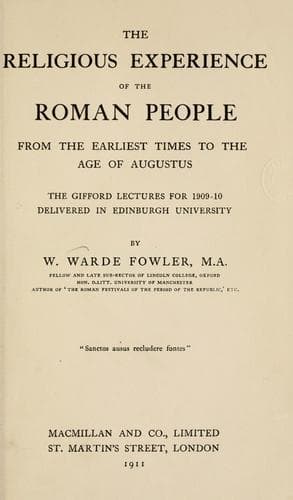
The Religious Experience of the Roman People: From the Earliest Times to the Age of AugustusFowler, W. Warde (William Warde)
Religion
The Religious Experience of the Roman People: From the Earliest Times to the Age of Augustus
Fowler, W. Warde (William Warde)
Cults -- Rome; Rome -- Religion
Whatever be the origin of the several forms of divination, the object of
the practice in ancient Italy and Greece is beyond doubt--to find out
whether the Power with whom you wish to be in right relation is
favourable to certain human operations, or willing to aid in removing
certain forms of human suffering. According to our definition, it was a
part of religion, whether or no it belonged originally to magic. It was
a practical expression of that doubt or anxiety to which I believe the
Romans attached the word _religio_. In the agricultural period it must
have been specially useful and even inevitable,[600] because the tiller
of the soil is always in need of knowledge as to the best times and
seasons for his operations, and his out-of-door life gives him constant
opportunity of observing natural phenomena, _diosemeia_, signs from
heaven, and the utterances and movements of birds and other animals. It
is interesting to reflect that these last may often be of real service
in foretelling the weather, which is so important to the farmer. As I
write this on a December day I recall the fact that I have myself within
the last week successfully foretold a spell of cold after observing a
great arrival of winter thrushes from the north. This particular branch
of augury is, in fact, neither so inadequate nor so absurd as most
others. Von Jhering may turn out to be right in his notion that at least
some forms of divination have their origin in practical needs and in the
skill of uncivilised man in discerning the signs of the weather--a skill
which it is well to remember far exceeds that of the house-dweller of
modern civilisation. But with the growth of the City-state and the
habits of life in a town, these early instincts and methods of the
agriculturist came to be caught up into a system of religious practice,
adapted to the conditions of civil and political existence; thus they
gradually lost their original meaning and such real value as they ever
possessed. I have pointed out that the Roman festivals and the ritual of
the oldest calendar gradually got out of relation with the agricultural
life in which they for the most part originated:[601] so it was with
divination, which in the hands of the State authorities became
formalised into a set of rules for ascertaining the good-will of the
gods, and obtaining their sanction for the operations of the community,
which had no scientific basis whatever, no relation to truth and fact.
Of all the methods for putting yourself in right relation with the
Power, this was the least valuable, and indeed the most harmful; it came
in course of time to be a positive obstacle to efficiency and freedom of
action, it wasted valuable time, and it often served as the means of
promoting private ends to the detriment of the public interest.
Public-domain text, read in full here on John Shaqi.
Reviews
Reviews
No reviews yet
Be the first to share your thoughts on this work.
Elsewhere in the archive
Join the Discussion
Join the discussion
Sign in to leave a comment or review.
Sign InorCreate an account