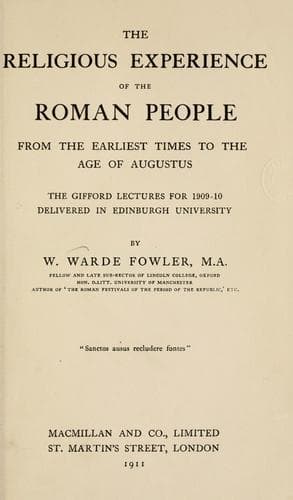
The Religious Experience of the Roman People: From the Earliest Times to the Age of AugustusFowler, W. Warde (William Warde)
Religion
The Religious Experience of the Roman People: From the Earliest Times to the Age of Augustus
Fowler, W. Warde (William Warde)
Cults -- Rome; Rome -- Religion
sacra_ but _loca religiosa_, technically because they were not the
property of the state or consecrated by it; in reality, I venture to
say, because the place where a corpse was deposited was of necessity
taboo. Such places were _extra commercium_, and their sanctity might not
be violated: "religiosum est," wrote the learned Roman Masurius Sabinus,
"quod propter sanctitatem aliquam _remotum et sepositum est_ a
nobis."[64] So, too, the great lawyer of Cicero's time, Servius
Sulpicius, defines _religio_ as "quae propter sanctitatem aliquam remota
ac seposita a nobis sit," where he is using _religio_ in the sense of a
thing or place to which a taboo attaches.[65] And again, another
authority, Aelius Gallus, said that _religiosum_ was properly applied to
an object in regard to which there were things which a man might not do:
"quod si faciat," he goes on, "adversus deorum voluntatem videatur
facere."[66] These last words are in the language of the City-state; if
we would go behind it to that of an earlier age, we should substitute
words which would express the feeling or scruple, the _religio_, without
reference to any special deity. Virgil has pictured admirably this
feeling as applied to places, in describing the visit of Aeneas to the
site of the future Rome under the guidance of his host Evander (_Aen._
viii. 347):--
hinc ad Tarpeiam sedem et Capitolia ducit,
aurea nunc, olim silvestribus horrida dumis.
_iam tum religio pavidos terrebat agrestis_
_dira loci_: iam tum silvam saxumque tremebant.
"hoc nemus, hunc," inquit, "frondoso vertice collem,
(quis deus, incertum est) habitat deus."
This is a passage on which I shall have to comment again: at present I
will content myself with noting how accurately the poet, who of all
others best understood the instincts of the less civilised Italians of
his own day, has used his knowledge to express the antique feeling that
there were places which man must shrink from entering--a feeling far
older than the invention of legal _consecratio_ by the authorities of a
City-state.
Lastly, the principle of taboo, or _religio_, if we use the Latin word,
affected certain times as well as places. Just as under the _ius
divinum_ of the fully-developed State certain spots were made over to
the deities for their habitation and rendered inviolable by
_consecratio_, so certain days were also appointed as theirs which the
human inhabitants might not violate by the transaction of profane
business. But I have just pointed out that the consecration of holy
places in this legal fashion was a late development of a primitive
feeling or _religio_; exactly the same, if I am not mistaken, was the
case with regard to the holy days. These were called _nefasti_, and
belong to the life of the State; but there were others, called
_religiosi_, which I believe to have been tabooed days long before the
State arose.
Public-domain text, read in full here on John Shaqi.
Reviews
Reviews
No reviews yet
Be the first to share your thoughts on this work.
Elsewhere in the archive
Join the Discussion
Join the discussion
Sign in to leave a comment or review.
Sign InorCreate an account