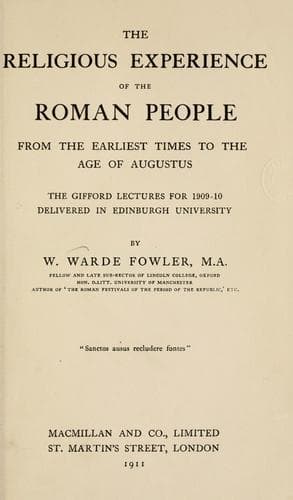
The Religious Experience of the Roman People: From the Earliest Times to the Age of AugustusFowler, W. Warde (William Warde)
Religion
The Religious Experience of the Roman People: From the Earliest Times to the Age of Augustus
Fowler, W. Warde (William Warde)
Cults -- Rome; Rome -- Religion
I am strongly inclined to suggest that the traditional explanation of
the tabooing of these thirty-six, or possibly seventy-two days was
neither more nor less than an aetiological myth, like hundreds of others
which were invented to account for Roman practices, religious and other;
and this supposition seems to be confirmed as we go on with the list of
_dies religiosi_ as given by Wissowa. The three days--Sextilis 24,
October 5, November 8--on which the Manes were believed to come up from
the underworld through the _mundus_ (to which I shall return later on)
were _religiosi_;[72] so were those when the temple of Vesta remained
open (June 7 to 15),[73] those on which the Salii performed their
dances in March and October,[74] two days following the _feriae Latinae_
(a movable festival),[75] and the days of the Parentalia in February and
the Lemuria in May, which were concerned with the cult and the memory of
the dead.[76] Now the _religio_ or taboo on these days obviously springs
either from a feeling of anxiety suggested by very primitive notions of
the dead and of departed spirits; or in the case of the temple of Vesta,
by some mystical purification or disinfection preparatory to the
ingathering of the crops, which I noticed in my _Roman Festivals_ (p.
152 foll.); or again in the case of the Salii, by some danger to the
crops from evil spirits, etc., which might be averted by their peculiar
performances. In fact, all these _dies religiosi_ date as such, we may
be pretty sure, from a very primitive period before the genesis of the
City-state, and were not recognised--for what reason we will not at
present attempt to guess--as _religiosi_ by the authorities who drew up
the Calendar. Some of them appear in that calendar as _dies nefasti_,
but not all; and I am entirely at one with Wissowa, whose knowledge of
the Roman religious law is unparalleled for exactness, in believing that
a _religio_ affecting a day had nothing whatever to do with its
character as _fastus_ or _nefastus_.[77]
Public-domain text, read in full here on John Shaqi.
Reviews
Reviews
No reviews yet
Be the first to share your thoughts on this work.
Elsewhere in the archive
Join the Discussion
Join the discussion
Sign in to leave a comment or review.
Sign InorCreate an account