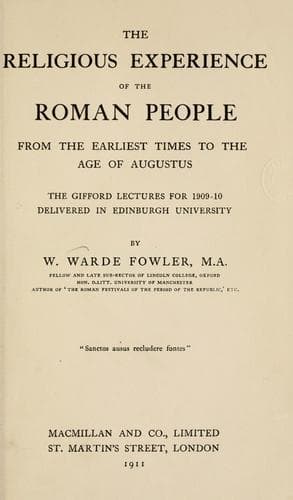
The Religious Experience of the Roman People: From the Earliest Times to the Age of AugustusFowler, W. Warde (William Warde)
Religion
The Religious Experience of the Roman People: From the Earliest Times to the Age of Augustus
Fowler, W. Warde (William Warde)
Cults -- Rome; Rome -- Religion
[59] Dion. Hal. iii. 45; Mommsen in _C.I.L._ i. p. 177.
It may be as well to point out that iron, like wheat in
the taboos of the Flamen, was considered dangerous, as
being a novelty. The old Italian grain was not true
wheat but _far_, which continued to be used in religious
rites; _R.F._ p. 304, and Marquardt, _Privatleben der
Roemer_, p. 399 foll.
[60] Varro, _L.L._ vii. 84; Ovid, _Fasti_, i. 629;
Petronius, _Sat._ 44. There are many parallels in Greek
ritual.
[61] See below, p. 146. Mr. Marett suggests to me a
comparison with the _rongo_ (sacred) of the Melanesians,
and _tapu_ as used of a place by them, _i.e._ set apart
by a human authority; Codrington, _Melanesians_, p. 77.
[62] Wissowa, _R.K._ p. 408 foll.; cp. 323 and notes.
[63] The fullest account of this will be found in
Marquardt, p. 262 foll. For the case of a man killed by
lightning, see note 4 on p. 263; the body was not burnt
but buried, and the grave became a _bidental_, and
_religiosum_.
[64] For the intricate pontifical law of burial-places
see Wissowa, p. 409. The quotation from Masurius is in
Gellius iv. 9. 8, "M. Sabinus in commentariis quos de
indigenis composuit." The word _sanctitas_ is here used
merely by way of explanation and not in a technical
sense; for which see Marq. p. 145 and references; but it
seems to have had a special use in the cult of the dead.
(See below, p. 470.)
[65] Quoted by Macrobius, _Sat._ iii. 3. 8. For
Sulpicius see _Social Life at Rome in the Age of
Cicero_, p. 118 foll.
[66] Festus, p. 278. This Aelius lived at the end of the
Republican period, and belonged to the school of
Sulpicius; Schanz, _Gesch. der roem. Lit._ i. pt. 2, p.
486.
[67] _e.g._ the three days on which the _mundus_ was
open were all _comitiales_, though at the same time
_religiosi_.
[68] _R.K._ pp. 376, 377.
[69] The authorities for the story are Verrius Flaccus,
_ap._ Gell. v. 17, and Macrobius, _Sat._ i. 16. 21.
[70] For the extent of the taboo see Gell. iv. 9. 5;
Macr. i. 16. 18.
[71] Gell. v. 17. 3 foll. (_annalium quinto_).
[72] Festus, p. 278.
[73] _R.F._ p. 151.
[74] Wissowa, _R.K._ p. 377, note 6.
[75] Cic. _ad Qu. Fratr._ ii. 4. 2.
[76] Wissowa, _R.K._ pp. 187, 189.
[77] _R.K._ p. 377. Gell. iv. 9. 5 says that the
_multitudo imperitorum_ confused the _dies religiosi_
and _dies nefasti_. The distinction is most clearly seen
in the fact that on _dies religiosi_ the temples were
(or ought to be) shut, and "res divinas facere" was
ill-omened (Gell., _ib._), while on _dies nefasti_ the
latter was regular, such days being made over to the
gods. No wonder that Gellius brands the popular
ignorance with such words as _prave_ and _perperam_.
Public-domain text, read in full here on John Shaqi.
Reviews
Reviews
No reviews yet
Be the first to share your thoughts on this work.
Elsewhere in the archive
Join the Discussion
Join the discussion
Sign in to leave a comment or review.
Sign InorCreate an account