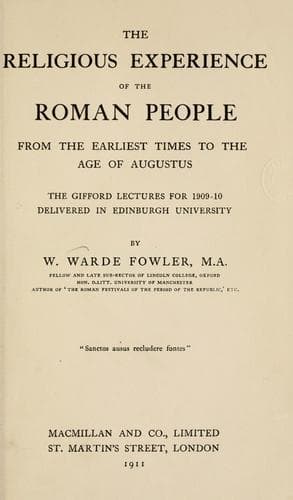
The Religious Experience of the Roman People: From the Earliest Times to the Age of AugustusFowler, W. Warde (William Warde)
Religion
The Religious Experience of the Roman People: From the Earliest Times to the Age of Augustus
Fowler, W. Warde (William Warde)
Cults -- Rome; Rome -- Religion
Some of the survivals mentioned in the last two lectures seem to carry
us back to a condition of culture anterior to the family and to the
final settlement on the land. Some attempt has recently been made to
discover traces of descent by the mother in early Latium;[131] if this
could be proved, it would mean that the Latins were already in Latium
before they had fully developed the patriarchal system on which the
family is based. However this may be, the first real fact that meets us
in the religious experience of the Romans is the attitude towards the
supernatural, or "the Power that manifests itself in the Universe," of
the family as settled down upon the land. The study of religion in the
family, as we know it in historical times, is also that of the earliest
organisation of religion, and of the most permanent type of ancient
Italian religious thought. Aust, whose book on the Roman religion is the
most masterly sketch of the subject as yet published, writes thus of
this religion of the family:[132] "Here the limits of religion and
superstition vanish ... and in vain we seek here for the boundary marks
of various epochs." By the first of these propositions he means that the
State has not here been at work, framing a _ius divinum_, including
religion and excluding magic; in the family, magic of all kinds would be
admissible alongside of the daily worship of the family deities, and
thus the family would represent a kind of half-way house between the age
of magic and all such superstitions, and the age of the rigid
regulation of worship by the law of a City-state. By the second
proposition he means that the religious experience of the family is far
simpler, and therefore far less liable to change than that of the State.
Greek forms and ideas of religion, for example, hardly penetrated into
its worship:[133] new deities do not find their way in--the family
experience did not call for them as did that of the State. It may be
said without going beyond the truth that the religion of the family
remained the same in all essentials throughout Roman history, and the
great priesthoods of the State never interfered with it in any such
degree as to affect its vitality.[134]
Public-domain text, read in full here on John Shaqi.
Reviews
Reviews
No reviews yet
Be the first to share your thoughts on this work.
Elsewhere in the archive
Join the Discussion
Join the discussion
Sign in to leave a comment or review.
Sign InorCreate an account