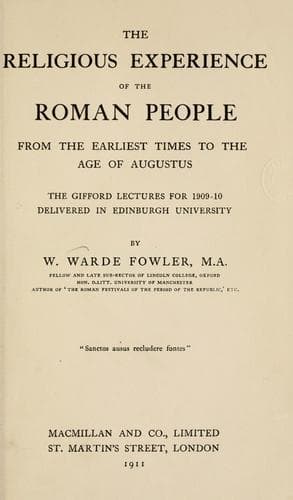
The Religious Experience of the Roman People: From the Earliest Times to the Age of AugustusFowler, W. Warde (William Warde)
Religion
The Religious Experience of the Roman People: From the Earliest Times to the Age of Augustus
Fowler, W. Warde (William Warde)
Cults -- Rome; Rome -- Religion
Let us begin with the house, the central point of the economic and
religious unit. The earliest Italian house was little more than a
wigwam, more or less round, constructed of upright posts connected with
wattles, and with a closed roof of straw or branches.[143] This would
seem to have been the type of house of the immigrating people who
settled on the tops of hills and lived a pastoral life; when they
descended into the plains and became a settled agricultural people, they
adopted a more roomy and convenient style of building, suitable for
storing their grain or other products, and for the maintenance of a fire
for cooking these. Whether the rectangular house, with which alone we
are here concerned, was developed under Greek or Etruscan influence, or
suggested independently by motives of practical convenience, is matter
of dispute, and must be left to archaeologists to decide.[144]
This is the house in which the Latin family lived throughout historical
times, the house which we know as the sacred local habitation of divine
and human beings. It consisted in its simplest form, as we all know, of
a single room or hall, the atrium, with a roof open in the middle and
sloping inwards to let the rain fall into a basin (_compluvium_). Here
the life of the family went on, and here was the hearth (_focus_), the
"natural altar of the dwelling-room of man,"[145] and the seat of Vesta,
the spirit of the fire, whose aid in the cooking of the food was
indispensable in the daily life of the settlers. This sacred hearth was
the centre of the family worship of later times, until under Greek
influence the arrangement of the house was modified;[146] and we may be
certain that it was so in the simple farm life of early Latium. In front
of it was the table at which the family took their meals, and on this
was placed the salt-cellar (_salinum_), and the sacred salt-cake, baked
even in historical times in primitive fashion by the daughters of the
family, as in all periods for the State by the Vestal virgins. After the
first and chief course of the mid-day meal, silence was enjoined, and an
offering of a part of the cake was thrown on to the fire from a small
sacrificial plate or dish (_patella_).[147] This alone is enough to
prove that Vesta, the spirit of the fire, was the central point of the
whole worship, the spiritual embodiment of the physical welfare of the
family.
Public-domain text, read in full here on John Shaqi.
Reviews
Reviews
No reviews yet
Be the first to share your thoughts on this work.
Elsewhere in the archive
Join the Discussion
Join the discussion
Sign in to leave a comment or review.
Sign InorCreate an account