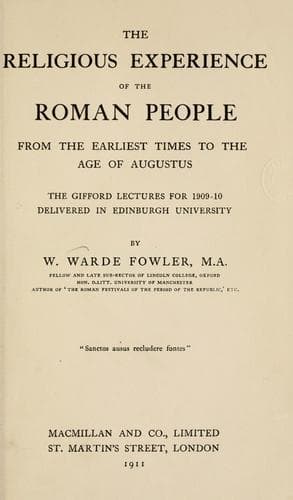
The Religious Experience of the Roman People: From the Earliest Times to the Age of AugustusFowler, W. Warde (William Warde)
Religion
The Religious Experience of the Roman People: From the Earliest Times to the Age of Augustus
Fowler, W. Warde (William Warde)
Cults -- Rome; Rome -- Religion
_religio terminorum_. The boundary-stone is garlanded, and an altar is
built; the fire is carried from the hearth of the homestead by a
materfamilias, the priestess of the family; a young son of the family
holds a basket full of fruits of the earth, and a little daughter shakes
these into the fire and offers honey-cakes. Others stand by with wine,
or look on in silence, clothed in white. The victims are lamb and
sucking-pig, and the stone is sprinkled with their blood, an act which
all the world over shows that an object is holy and tenanted by a
spirit.[175] And the ceremony ends with a feast and hymns in honour of
holy Terminus, who in Ovid's time in the rural districts, and long
before on the Capitolium of Rome, had risen from the spirit sanctifying
the stone to become a deity, closely connected with Jupiter himself, and
to give his name to a yearly city festival on February 23.
These festivals on the land were, some of them at least, scenes of
revelry, accompanied with dancing and singing, as the poets describe
them, the faces of the peasants painted red with minium,[176] according
to an old Italian custom which survived in the case of the triumphator
of the glorious days of the City-state. But if we may now return for a
moment to the homestead, there were events of great importance to the
family which were celebrated there in more serious and sober fashion,
with rites that were in part truly religious, yet not without some
features that show the prevailing anxiety, rooted in the age of taboo,
which we learnt to recognise under the word _religio_. Marriage was a
religious ceremony, for we can hardly doubt that the patrician
_confarreatio_, in which a cake made of the anciently used grain called
_far_ was offered to Jupiter, and perhaps partaken of sacramentally by
bride and bridegroom, was the oldest form of marriage, and had its
origin in an age before the State came into being. We must remember that
the house was a sacred place, with religious duties carried on within
it, and the abode of household spirits; and when a bride from another
family or gens was to be brought into it, it was essential that such
introduction should be carried out in a manner that would not disturb
the happy relations of the human and divine inhabitants of the house. It
was essential, too, that the children expected of her should be such as
should be able to discharge their duties in the household without
hurting the feelings of these spirits. Some of the quaint customs of the
_deductio_ of later times strongly suggest an original anxiety about
matters of such vital interest; the torch, carried by a boy whose
parents were both living, was of whitethorn (_Spina alba_), which was a
powerful protective against hostile magic, and about which there were
curious superstitions.[177] Arrived at the house, the bride smeared the
doorposts with wolf's fat and oil, and wound fillets of wool around
them--so dangerous was the moment of entrance, so sacred the doorway;
Public-domain text, read in full here on John Shaqi.
Reviews
Reviews
No reviews yet
Be the first to share your thoughts on this work.
Elsewhere in the archive
Join the Discussion
Join the discussion
Sign in to leave a comment or review.
Sign InorCreate an account