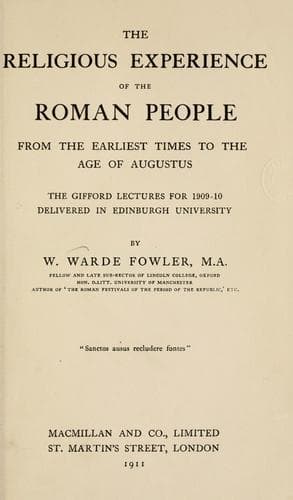
The Religious Experience of the Roman People: From the Earliest Times to the Age of AugustusFowler, W. Warde (William Warde)
Religion
The Religious Experience of the Roman People: From the Earliest Times to the Age of Augustus
Fowler, W. Warde (William Warde)
Cults -- Rome; Rome -- Religion
[149] See a paper by the author in _Classical Rev._ vol.
x. (1896) p. 317, and references there given. Cp. the
passage of Servius quoted above (_Aen._ i. 730), where a
boy is described as announcing at the daily meal that
the gods were propitious. For the purity necessary I may
refer to Hor. _Odes_, iii. 23 _ad fin._, "Immunis aram
si tetigit manus," etc.
[150] _Primitive Culture_, i. 393.
[151] The feminine counterpart of Genius was Juno, of
which more will be said later on. Each woman had her
Juno; but this "other-soul" has little importance as
compared with Genius.
[152] See J. B. Carter in Hastings' _Dict. of Religion
and Ethics_, i. 462 foll. For Genius in general, Birt in
_Myth. Lex._ s.v.; Wissowa, _R.K._ p. 154 foll.;
Stewart, _Myths of Plato_, p. 450, for the connexion of
souls with ancestry.
[153] See the fifth of Plutarch's _Quaestiones Romanae_,
and Dr. Jevons' interesting comments in his edition of
Phil. Holland's translation, pp. xxii. and xxxv. foll.
Cp. the throwing the fetters of a criminal out by the
roof of the Flamen's house.
[154] _Civ. Dei_, vi. 9. These are deities of the
Indigitamenta; see below, p. 84.
[155] De Marchi, _La Religione_, etc. i. 188 foll.;
Marquardt, _Privatleben der Roemer_, p. 336, "la porte
est la limite entre le monde etranger et le monde
domestique" (A. van Gennep, _Rites de passage_, p. 26,
where other illustrations are given).
[156] See below, Lect. XII. p. 281.
[157] Wissowa, _R.K._ p. 96; Aust, _Rel. der Roemer_, p.
117; Roscher in _Myth. Lex._ s.v. "Janus"; J. B. Carter,
_Religion of Numa_, p. 13. Cp. Von Domaszewski in
_Archiv_, 1907, p. 337.
[158] Frazer, _Lectures on the Early History of
Kingship_, p. 286 foll.; A. B. Cook in _Classical
Review_, 1904, p. 367 foll.
[159] _Gromat. vet._ i. 302, line 20 foll., describes
the chapels, but without mentioning the Lares. Varro
(_L.L._ vi. 25) supplies the name: "Compitalia dies
attributus Laribus Compitalibus; ideo ubi viae competunt
tum in competis sacrificatur." Cp. Wissowa, _R.K._ p.
148. But the nature of the land thus marked off is not
clear to me, nor explained (for primitive times) by
Wissowa in _Real-Encycl._, _s.vv._ "Compitum" and
"Compitalia."
[160] "Enos Lases juvate." See Henzen, _Acta Fratr.
Arv._ p. 26 foll.
[161] Cato, _R.R._ 5. Cp. Dion. Hal. iv. 13. 2. In Cato
143 the vilica is to put a wreath on the focus on
Kalends, Nones and Ides, and to pray to the Lar
familiaris pro copia (at the compita?).
[162] Marquardt, _Privatleben_, p. 172.
Public-domain text, read in full here on John Shaqi.
Reviews
Reviews
No reviews yet
Be the first to share your thoughts on this work.
Elsewhere in the archive
Join the Discussion
Join the discussion
Sign in to leave a comment or review.
Sign InorCreate an account