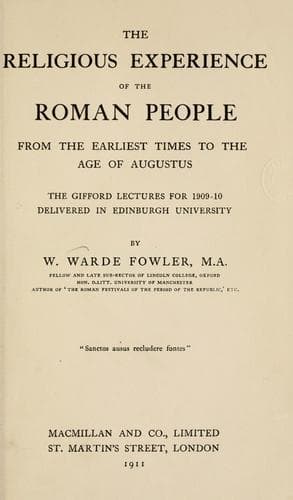
The Religious Experience of the Roman People: From the Earliest Times to the Age of AugustusFowler, W. Warde (William Warde)
Religion
The Religious Experience of the Roman People: From the Earliest Times to the Age of Augustus
Fowler, W. Warde (William Warde)
Cults -- Rome; Rome -- Religion
The smaller capitals give us such entries as _feriae Iovi_, _feriae
Saturno_, _i.e._ the name of a deity to whom a festival was sacred, the
foundation days of temples, generally with the name of the deity in the
dative and the position of the temple in the city, and certain _ludi_
and memorial days, which belong to a much later age than the original
festivals. But the names of those which are inscribed in large letters
bear witness beyond all question to their own antiquity; for among them
there is not one which has anything to do, so far as we know, with a
non-Roman deity, and we know that foreign deities began to arrive in
Rome before the end of the kingly period. Here, then, we have genuine
information about the oldest religious doings of the City-state, in what
indeed is, as Mommsen said, the most ancient source of our knowledge
about Roman antiquity generally.
The first point we notice in studying this calendar (putting aside for
the present the question as to the agency by which it was drawn up) is
this: it exactly reflects a transition from the life of a rural
population engaged in agriculture, to the highly-organised political and
military life of a City-state. In other words, the State, whose
religious needs and experience it reflects, was one whose economic basis
was agriculture, whose life included legal and political business, and
whose activity in the season of arms was war.
This last characteristic is discernible chiefly, if not entirely, in the
months of March and October; and the former of these bears the name of
the great deity, who, whatever may have been his origin or the earliest
conception of him, was throughout Roman history the god of war. All
through March up to the 23rd the Salii, the warlike priests of Mars,
were active, dancing and singing those hymns of which an obscure
fragment has come down to us, and clashing and brandishing the sacred
spears and shields of the god (_ancilia_).[191] On the 19th these
ancilia were lustrated--a process to which I shall recur in another
lecture; and on the 23rd we find in the calendar the festival
Tubilustrium, which suggests the lustration of the trumpets of the host
before it took the field. On the 14th of March,[192] and also on the
27th of February, we find Equirria in the calendar, which must be
understood as lustrations of the horses of the host, accompanied with
races. If we may take the ancilia as symbolising the arms of the host,
we see in the festivals of this month a complete religious process
preparing the material of war for the perils inevitably to be met with
beyond the _ager Romanus_, whether from human or spiritual enemies; and
that the warriors themselves were subjected to a process of the same
kind we know from the historical evidence of later times.[193] Now in
October, when the season of arms was over, we find indications of a
parallel process, which Wissowa was the first to point out clearly, but
Public-domain text, read in full here on John Shaqi.
Reviews
Reviews
No reviews yet
Be the first to share your thoughts on this work.
Elsewhere in the archive
Join the Discussion
Join the discussion
Sign in to leave a comment or review.
Sign InorCreate an account