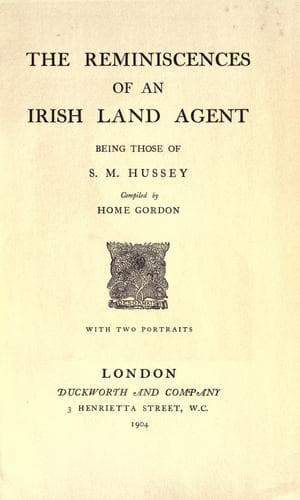
The Reminiscences of an Irish Land AgentHussey, Samuel Murray
History
The Reminiscences of an Irish Land Agent
Hussey, Samuel Murray
Country life -- Ireland; Hussey, Samuel Murray, 1824-; Ireland -- History -- 1837-1901
'Kilcockan parish between Lismore and Youghal was in great part disposed
of in the Landed Estates Court thirty years ago. It was bought, some of
it by occupiers, some of it by shopkeepers and attorneys. Rents have
been raised, and there is not much appearance of prosperity. Newtown,
for several generations the fee-simple property of a family of the name
of Nason, after the famine of 1846, was cut up and sold; the family
residence is in ruin. At Lower Curryglass, a few miles east of Lismore,
a good farm of five hundred acres, belonging to a family who have been
obliged to leave it, bears sad evidence of neglect; the good old
deserted manor-house, the farm buildings, and a dozen cottages in the
village are falling to pieces. Contrary to what might be anticipated,
some of the smaller proprietors in this district have been strenuous
supporters of the Land League, although it is to be hoped that they
repudiate the destruction of the cattle on the land of Mr. Grant, which
were stabbed, and some of them drowned in the river. Mr. Grant had come
under the ban of the League for evicting a dissipated bankrupt tenant,
whose debts to the extent of two hundred pounds he had paid, and who
would have been reinstated, if there had been the remotest prospect of
reformed habits or of getting clear of his difficulties. Such acts
appear to justify the statement, "that Irishmen don't know what they
want, and won't be satisfied until they get it."'
God knows we have waded knee deep in blood of men, and domestic animals
since that was written, yet to-day are we any nearer the final solution
of the Irish difficulties? In my opinion, certainly not.
CHAPTER XVII
THE STATE OF KERRY
It has been stated that it is only within the last forty years that the
bulk of the people of Ireland, long outside the pale of the ballot-box,
have actively entered political life. This is quite true.
The whole of the Home Rule troubles followed the presentation of
practically universal suffrage to the half-educated and
over-enthusiastic Irish, who are easily led away, apt to believe
mob-orators, and, by inherited instinct, to go against the Government.
What the effect of universal suffrage in India would be it is not my
business to estimate. Still, the analogy of what the ballot-paper
provided in Ireland, if applied to the teeming population of our
Oriental Empire, suggests a pandemonium to which the horrors of the
Mutiny are but a mere scream of agony.
The ballot transformed Ireland; or rather, it permitted the worst
passions of the most ignorant to be played upon by interested
adventurers, when the political power of Ireland had passed for ever out
of the hands of the restraining classes. Democracy spelt anarchy, and
the word patriotism was degraded in a way that had no parallel since the
French Revolution.
Public-domain text, read in full here on John Shaqi.
Reviews
Reviews
No reviews yet
Be the first to share your thoughts on this work.
Elsewhere in the archive
Join the Discussion
Join the discussion
Sign in to leave a comment or review.
Sign InorCreate an account