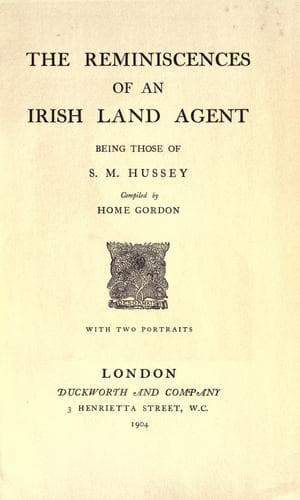
The Reminiscences of an Irish Land AgentHussey, Samuel Murray
History
The Reminiscences of an Irish Land Agent
Hussey, Samuel Murray
Country life -- Ireland; Hussey, Samuel Murray, 1824-; Ireland -- History -- 1837-1901
At that time two-thirds of the poor-rate was paid by the landlord. When
the tenancy was over L4 a year, they had to allow each tenant half the
rate he paid; when it was under this sum, they had to pay the whole of
it, and, of course, all the rates for land in their own occupation.
Thus the Board of Guardians were utilising the money of the landlords in
order to remunerate the men who were robbing them of their property.
If a tenant--who generally had some money--was evicted, a notice was
served on the relieving officer to provide him with a conveyance, in
which he was taken to the poorhouse; but if a farmer evicted a
labourer--who had, perhaps, nothing but the suit of clothes in which he
stood up--he was allowed to walk to the poorhouse as best he might, and,
when he got there, he obtained no special relief.
It is true that the passing of the Habeas Corpus Suspension Act offered
another opportunity to the Government for striking a severe blow, but it
was frittered away, although, before it became law, many of the leaders
of disorder left the country, dreading its provisions.
Instead, the isolated arrests revealed that the criminals were provided
with special accommodation and superior fare.
A district officer, asked by Lord Spencer for his views on the Coercion
Act, replied:--
'The only coercion I can perceive, your Excellency, is that people
accustomed to live on potatoes and milk are forced to feed on salmon and
wine.'
The last outrage I intend to mention in this chapter was a very
remarkable one.
There was a contest for the chairmanship of the Tralee Board of
Guardians. The Land League put forward a candidate who was at the time
an inmate of Kilmainham gaol. The landlords, who at this earlier stage
still had some power, conceived that the residence of the Home Ruler
would not facilitate his control over the Board, and chose a candidate
whose abode was not only more adjacent, but whose movements were
unfettered.
The voting was even, until Mr. A.E. Herbert came into the room and gave
his casting vote against the involuntary tenant of the Kilmainham
hostelry. For this he was murdered three days later, and by the crime
they hoped to ensure that on the next occasion the landlords would
abstain from voting at all.
Public-domain text, read in full here on John Shaqi.
Reviews
Reviews
No reviews yet
Be the first to share your thoughts on this work.
Elsewhere in the archive
Join the Discussion
Join the discussion
Sign in to leave a comment or review.
Sign InorCreate an account