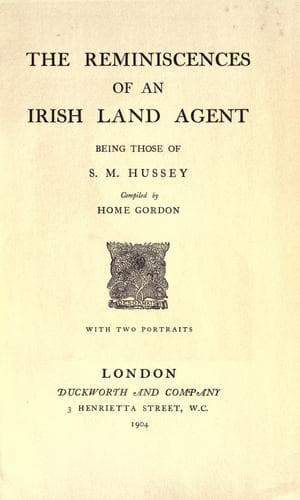
The Reminiscences of an Irish Land AgentHussey, Samuel Murray
History
The Reminiscences of an Irish Land Agent
Hussey, Samuel Murray
Country life -- Ireland; Hussey, Samuel Murray, 1824-; Ireland -- History -- 1837-1901
'Here is something about a man who ought to have been murdered any day
since 1879--indeed we don't know that he should have been let live even
up to that date, and as for his family, their translation to the upper
regions by means of a simple charge of dynamite, which nobody of any
sense or importance would even think of condemning, has been most
unaccountably deferred to the present year. This man is Mr. S.M. Hussey,
the miasma of whose breath, according to a well-informed murder organ in
Dublin, poisons one-half of the kingdom of Kerry. Let any man read the
speeches delivered in Upper Sackville Street, and the articles in
_United Ireland_ against Mr. Hussey, and he must ask why the fiend
incarnate has not been murdered long since. The infamy of persistently
turning hatred on a man like Mr. Hussey, and then escaping the
consequences of having thereby murdered him, has no parallel in any
country in the world. Inciting to murder is practically reduced to a
science in Ireland. That Mr. Hussey has not been murdered years ago is
not the fault of the scientist, but the watchfulness of the police.'
My experience while in England had been that few people I met really
appreciated what boycotting was like, so how are my readers of twenty
years afterwards to do so? Yet when I went back to Ireland, it seemed to
me even more cruel than when I had grown comparatively accustomed by
sheer proximity to it.
Mr. Parnell had himself given the order in a public speech:--
'Shun the man who bids for a farm from which a tenant has been evicted,
shun him in the street, in the shop, in the marketplace, even in the
place of worship, as if he were a leper of old.'
This was done with the thoroughness which characterises Irishmen when
back-sliding into unimaginable cruelties. Should a boycotted man enter
chapel, the whole congregation rose as with one accord and left him
alone in the building. Considering the sensitive and pious disposition
of the average Irishman, such ostracism was even more poignant than it
would be to an Englishman.
Only two families in Kerry, possibly in Munster, at Christmas 1885, had
the courage to resist the National League police, commonly called
moonlighters. These two were the Curtins and the Doyles. The Curtins had
to be under constant police protection, were insulted wherever they
went, and their murdered father was openly called 'the murderer.' As for
the Doyles, the Board of Guardians was urged to harass his unfortunate
children, who were both deaf and dumb.
The same Board of Guardians was most lavish in its relief to any man
evicted for declining to pay his rent. In one case they gave a man
fifteen shillings a week--or treble the ordinary out-of-door relief--for
over six years.
Sir James Stephen, a man of acute discriminations, who has done more
justice to the Irish problem than any one else, wrote:--
Public-domain text, read in full here on John Shaqi.
Reviews
Reviews
No reviews yet
Be the first to share your thoughts on this work.
Elsewhere in the archive
Join the Discussion
Join the discussion
Sign in to leave a comment or review.
Sign InorCreate an account