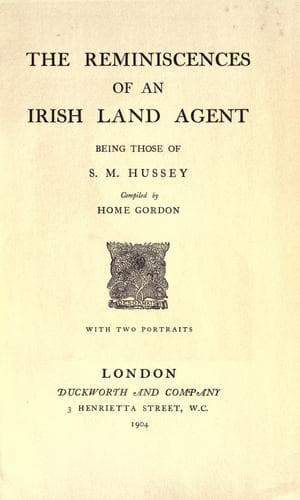
The Reminiscences of an Irish Land AgentHussey, Samuel Murray
History
The Reminiscences of an Irish Land Agent
Hussey, Samuel Murray
Country life -- Ireland; Hussey, Samuel Murray, 1824-; Ireland -- History -- 1837-1901
There is yet another case I cannot forbear from handing on to a
generation that knows no outrages nearer home than Macedonia. Six
ruffians, having their faces covered with handkerchiefs, and armed with
heavy cudgels, entered the house of a farmer named Lambe and began to
beat him. To save his head from the blows, he ran the upper part of his
body up the chimney and held on by the cross-bar. His wife, on coming to
his assistance, was beaten so severely that her skull was fractured,
while an aged female--stated to be in her ninety-seventh year--was not
only roughly handled, but also beaten. A most discreditable episode
indeed, in a land formerly renowned for respect for womanhood, and for
the warm-hearted generosity of her sons.
In only one instance in Kerry was police protection being regarded as
necessary up to the present summer, and all who know the contemporary
condition of affairs will at once recollect that Mrs. Morrogh Bernard is
the lady in question.
The late Mr. Edward Morrogh Bernard of Fahagh Court, Bullybrack, was a
Roman Catholic, who had resided in Kerry all his life, and some
five-and-twenty years ago he built on his property the residence in
which he died in the spring of 1904. He and his wife, an English lady,
who was justly beloved for her wide charity, were one night, after
dinner, sitting in their drawing-room, when a party of masked
moonlighters walked in. One of them held a pistol to her head, and told
her not to scream or move, else he would shoot her. Another performed
the same kindly office for Mr. Bernard, whilst the rest ransacked the
house for arms and money.
Mrs. Bernard noticed that the hands of the man who was threatening her
with violence were not those of an agricultural labourer, because they
were small and white. On the strength of this clue, the police arrested
a little tailor in the village, and she courageously identified him in
court, though every possible pressure was brought on her not to do so.
He was sentenced to several years' imprisonment, and his friends vowed
they would make it hot for Mrs. Bernard, and ever after she has been
protected by two or three constables. The police did not live in Fahagh
Court, but in a hut specially built for them a few yards off, and at
night they always came into the house. To the very last days of Mr.
Bernard's life whenever he and she went to pay a call on a neighbour,
two policemen followed them either on a car or on bicycles, and I have
never heard any reasons advanced to show that these precautions were
superfluous.
Meeting this little party on the highway was the only thing in the
twentieth century which brought home to the British tourist the terrible
deeds which blackened Kerry in the eighties.
I have always looked on the light side of life, even when it has seemed
blackest, and so I will not close this chapter without a more cheery
anecdote.
Public-domain text, read in full here on John Shaqi.
Reviews
Reviews
No reviews yet
Be the first to share your thoughts on this work.
Elsewhere in the archive
Join the Discussion
Join the discussion
Sign in to leave a comment or review.
Sign InorCreate an account