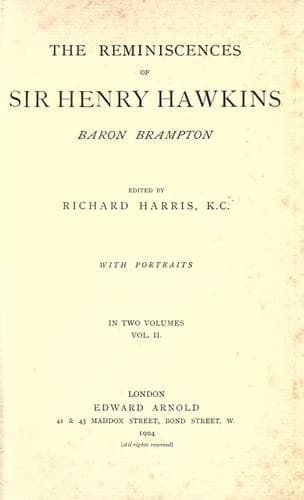
The Reminiscences of Sir Henry Hawkins (Baron Brampton)Brampton, Henry Hawkins, Baron
History
The Reminiscences of Sir Henry Hawkins (Baron Brampton)
Brampton, Henry Hawkins, Baron
Brampton, Henry Hawkins, Baron, 1817-1907; Judges -- Great Britain -- Biography
What made things worse, there was not only no effort made to curtail
the business, but advantage was taken of every circumstance to prolong
it. The longer it was dragged out the better chance there was of an
acquittal. Had a juryman died after months of the trial had passed,
the Government must have abandoned the prosecution. It would have been
impossible to commence again. This was the last hope of the defence.
[The trial before Bovill ended at last, as it ought to have done
months before, in a verdict for the defendants and the order for the
prosecution of the Claimant for perjury. It was this prosecution that
occupied the attention of the court and of the world for 188 days,
extending over portions of two years.
There is no doubt that Coleridge would a second time have deprived
the country of Mr. Hawkins's services, but higher influences than his
prevailed, and the distinguished counsel was appointed to lead for the
Crown, with Mr. Serjeant Parry as his leading junior. It is not too
much to say that no one knew the case so well as Mr. Hawkins, and none
could have done it so well. Bowen and Mathews were also his juniors.
The whole case, from the commencement of the Chancery proceedings down
to the commencement of this trial, had been a comedy of blunders. The
very claim was an absurdity, every step in the great fraud was an
absurdity, and every proceeding had some ridiculous absurdity to
accompany it. It was not until the cross-examination of Baigent by Mr.
Hawkins that the undoubted truth began to appear.
"You are the first," said Baron Bramwell, "who has let daylight into
the case." It will be seen presently what the simple story was which
the learned counsel at last evolved from the lies and half-truths
which had for so many years imposed upon a great number even of the
intelligent and educated classes of the community. And I would observe
that until nearly the end of the trial the case was never safe or
quite free from doubt; it was only what was elicited by Mr. Hawkins
that made it so. No Wonder the advocate said to Giffard, who was
opposed to him on the first trial: "If you and I had been together
in that case in the first instance, we should have won it for the
Claimant." Being on the other side, this is how the case stood when he
had completed it:--
The real heir to the family was a fairly well-formed, slender youth of
medium height. The personator of this youth was a man an inch and a
half or two inches taller, and weighing five-and-twenty stone. His
hands were a great deal larger than those of Roger, and at least an
inch longer; his feet were an inch and a half longer. He was broader,
deeper, thicker, and altogether of a different build. The lobes of his
ears, instead of being pendent like Roger's, adhered to his cheeks.
But he was not more unlike in physical outline than in mental
endowment, taste, character, pursuits, and sentiment, in manners and
habits, in culture and education, connection and recollection.
Public-domain text, read in full here on John Shaqi.
Reviews
Reviews
No reviews yet
Be the first to share your thoughts on this work.
Elsewhere in the archive
Join the Discussion
Join the discussion
Sign in to leave a comment or review.
Sign InorCreate an account