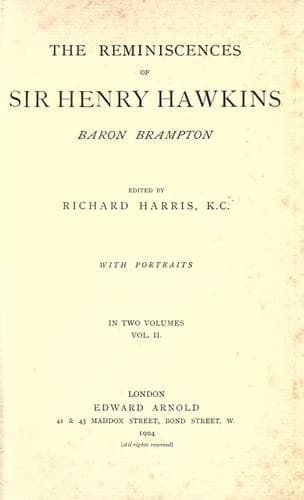
The Reminiscences of Sir Henry Hawkins (Baron Brampton)Brampton, Henry Hawkins, Baron
History
The Reminiscences of Sir Henry Hawkins (Baron Brampton)
Brampton, Henry Hawkins, Baron
Brampton, Henry Hawkins, Baron, 1817-1907; Judges -- Great Britain -- Biography
I am not going to relate the details of that extraordinary case,[A]
which are best left in the obscurity of the newspaper files; but I
refer to it because it cannot well be passed over in the reminiscences
of my life. I shall, however, only touch upon one or two prominent
points.
[Footnote A: The great sensation of the case was almost overpowered by
the great sensation that "a new power had come upon the Bench." These
are, as nearly as I can give them, the words of one of our most
distinguished advocates, and one of the most brilliant who was in the
Penge case:--
"We felt, and the Bar felt, that a great power had come upon the
Bench; he summed up that case as no living man could have done. Every
word told; every point was touched upon and made so clear that it was
impossible not to see it."
Another distinguished advocate said there was no other Judge on
the Bench who could have summed that case up as Sir Henry Hawkins
did.--R.H.]
"Every person," I said in my summing up, "who is under a legal duty,
whether such duty was imposed by law or contract, to take charge of
another person must provide that person with the necessaries of life.
Every person who had that legal duty imposed upon him was criminally
responsible if he culpably neglected that duty, and the death of the
person for whom he ought to provide ensued. If the death was the
result of mere carelessness and without criminal intent, the offence
would be manslaughter, provided the jury came to the conclusion that
there had been culpable neglect of the duty cast upon the individual
who had undertaken to perform it."
With regard to the evidence of one of the witnesses who was said to
be an accomplice, so that it was necessary that she should be
corroborated, I said a jury might convict without it, but recommended
them strongly not to take for granted her evidence unless they found
there was so much corroboration of her testimony as to induce them to
believe she was telling the truth.
As to one of the accused, I said: "If she had no legal object to
fulfil in providing the deceased with the necessaries of life, the
mere omission to do so would not render her guilty; but if she did an
act wrongfully which had a tendency to destroy life, but which was not
clone with that intention, she would be guilty of manslaughter."
The jury found a verdict of guilty against all, but with a strong
recommendation in favour of one, in which I joined.
When a verdict of guilty of wilful murder is returned, a Judge,
whatever may be his opinion of its propriety or justice, has no
alternative but to deliver the sentence of death, and in the very
words the law prescribes. It is not _his_ judgment or decision, but
it is so decreed that the sentence shall in no way depend upon the
sympathy or opinion of the Judge. Whatever mitigating circumstances
there may be must be considered by the Secretary of State for the Home
Department as representing the Sovereign, and upon his advice alone
the Sovereign acts.
Public-domain text, read in full here on John Shaqi.
Reviews
Reviews
No reviews yet
Be the first to share your thoughts on this work.
Elsewhere in the archive
Join the Discussion
Join the discussion
Sign in to leave a comment or review.
Sign InorCreate an account