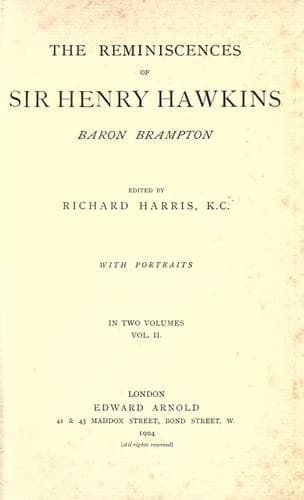
The Reminiscences of Sir Henry Hawkins (Baron Brampton)Brampton, Henry Hawkins, Baron
History
The Reminiscences of Sir Henry Hawkins (Baron Brampton)
Brampton, Henry Hawkins, Baron
Brampton, Henry Hawkins, Baron, 1817-1907; Judges -- Great Britain -- Biography
[In a case at Devizes Sir Henry showed in a striking manner the
character he always bore as a humane Judge. He was not humane where
cruelty was any part of the culprit's misdeeds, for he visited that
with the punishment he thought it deserved, and his idea of that was
on a somewhat considerable scale.]
I was down upon cruelty, and always lenient where there were any
mitigating circumstances whatever, either of mental weakness, great
temptation, provocation, or unhappy surroundings.
A woman was brought up before me who had been committed to take her
trial on a charge of concealing the birth of a child. For prisoners
in these circumstances I always felt great sympathy, and regarded the
moral guilt as altogether unworthy of punishment. The law, however,
was bound to be vindicated so far as the legal offence was concerned.
She had already been in prison for three months, because she was too
poor and too friendless to find bail. I am always pointing out that
if magistrates would send more cases to the Judges than they do, they
would get some precedents as to the appropriate measure of punishment,
which they seem badly to need. This woman had already been punished,
without being found guilty, with three times the punishment she ought
to have received had she been found guilty. A month's imprisonment
would have been excessive.
Prisoners should always be released on their own recognizances where
there is a reasonable expectation that they will appear.
The result was that the unhappy woman, who had been punished severely
while in the eye of the law she was innocent, was discharged when she
was found to be guilty.
We have seen how Mr. Justice Maule examined a little boy as to his
understanding the nature of an oath. I once examined a little girl
upon a preliminary point of this kind, before she had arrived at that
period of mental acuteness which enables one to understand exactly the
meaning of the words uttered in the administration of the oath. The
child was called, and after allowing the form of "the evidence you
shall give," etc., and "kiss the book," to be gabbled over, I said,
before the Testament could reach the child's lips,--
"Stop! Do you understand what that gentleman has been saying?"
"No, sir."
I think it is a great farce to let little children be sworn who cannot
be expected to understand even the language in which the oath is
administered, to say nothing of the oath itself. How can they
comprehend the meaning of the phrases employed? And many grown-up
uneducated people are in the same situation. Surely a simple form,
such as, "_You swear to God to speak the truth_"--or, even better
still, to make false evidence punishable without any oath at
all--would be far better.
CHAPTER XXXIII.
JACK.
I was always fond of dogs, and never cease to admire their
intelligence and sagacity.
Public-domain text, read in full here on John Shaqi.
Reviews
Reviews
No reviews yet
Be the first to share your thoughts on this work.
Elsewhere in the archive
Join the Discussion
Join the discussion
Sign in to leave a comment or review.
Sign InorCreate an account