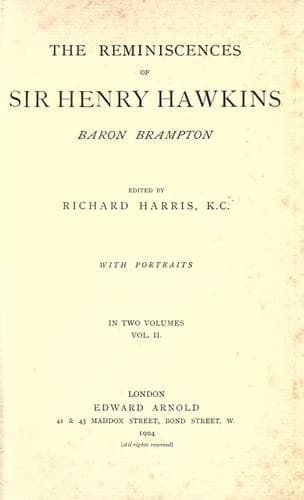
The Reminiscences of Sir Henry Hawkins (Baron Brampton)Brampton, Henry Hawkins, Baron
History
The Reminiscences of Sir Henry Hawkins (Baron Brampton)
Brampton, Henry Hawkins, Baron
Brampton, Henry Hawkins, Baron, 1817-1907; Judges -- Great Britain -- Biography
But there they were, and this was the story of their lives:--
The man, after the separation, lived for some time single, then formed
a companionship, and, as he afterwards heard that his wife had got
married to some one else, thought he would follow her example.
Now, if a Judge punished immorality, here was something to punish; but
the law leaves that to the ecclesiastical or some other jurisdiction.
The Judge has but to deal with the breach of the law, and to punish in
accordance with the requirements of the injury to society--not even to
the injury of the individual.
I made inquiries of the police and others, as the prisoners had
pleaded guilty, and found that all the parties--the four persons--had
been living respectable and hard-working lives. There was no fault
whatever to be found with their conduct. They were respected by all
who knew them.
I then asked how it was found out at last that these people, living
quietly and happily, had been previously married.
"O my lord," said a policeman, "there was a hinquest on a babby, which
was the female prisoner's babby and what had died. Then it come out
afore Mr. Coroner, my lord, and he ordered the woman into custody, and
then the man was took."
I thought they had had punishment enough for their offence, and gave
them no imprisonment, but ordered them to be released on their own
recognizances, and to come up for judgment if called upon.
Now came _my_ sentence. The clergyman of the parish in which this
terrible crime had been discovered evidently felt that he had been
living in the utmost danger for years. Here these people came to his
church, and for aught he knew prayed for forgiveness under the very
roof where he himself worshipped.
He said I had done a fine thing to encourage sin and immorality, and
what could come of humanity if Judges would not punish?
He denounced me, I afterwards learned, in his pulpit in the severest
terms, although I did not hear that he used the same vituperative
language towards the poor creatures I had so far absolved. Luckily I
was not attending the reverend gentleman's ministration, but he seemed
to think the greatest crime I had committed was disallowing the costs
of the prosecution. That was a direct _incentive to bigamy_, although
in what respect I never learned.
It sometimes suggested to my mind this question,--
What would this minister of the gospel have said to the Divine Master
when the woman caught "in the very act" was before Him, and He said,
in words never to be forgotten till men and women are no more,
"Neither do I condemn thee"?
I thought those who loved a prosecution of this kind--whoever it may
have been--_ought_ to pay for the luxury, and so I condemned _them_ in
the costs.
CHAPTER XL.
DR. LAMSON[A]--A CASE OF MISTAKEN IDENTITY--A WILL CASE.
Public-domain text, read in full here on John Shaqi.
Reviews
Reviews
No reviews yet
Be the first to share your thoughts on this work.
Elsewhere in the archive
Join the Discussion
Join the discussion
Sign in to leave a comment or review.
Sign InorCreate an account