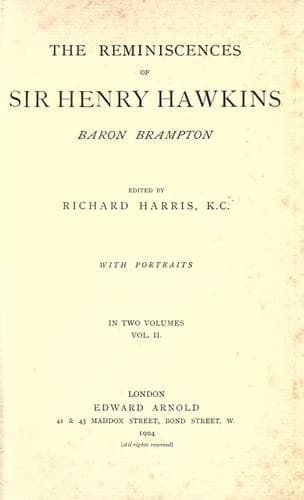
The Reminiscences of Sir Henry Hawkins (Baron Brampton)Brampton, Henry Hawkins, Baron
History
The Reminiscences of Sir Henry Hawkins (Baron Brampton)
Brampton, Henry Hawkins, Baron
Brampton, Henry Hawkins, Baron, 1817-1907; Judges -- Great Britain -- Biography
It shows how fatal it may be in Judge, counsel, or jury to take
anything for granted in a criminal charge. It had been taken for
granted at the former trial that _five_ men had entered the field, and
how the counsel for the defence could have done so I am at a loss to
conceive. It was further ascertained that the same number and the
_same footprints_ marked the steps of those coming _out_ of the field.
It went even further, for it was proved that _no footprints of a fifth
man were anywhere visible on any other part of the field_, although
the most careful search had been made.
If this was established, as I think it was beyond all controversy,
it clearly proved that only _four men_ were in the field when the
injuries were inflicted. But it might, nevertheless, be that the young
man identified was one of the four. Whether he was or not was now the
question at issue; it was reduced to that one point. To disprove this
the prisoner said he would like the men to be called. I cautioned him
again as to the danger of the course he proposed, feeling that he was
pretty safe as it was in the hands of the jury. They could hardly
convict under my ruling in the circumstances.
"No, my lord," he said; "I am _sure they will speak the truth about
it_. They will not swear falsely against me to save themselves."
The man who was alleged to have borrowed the cap was then brought up,
and I asked him if it was true that he wore the prisoner's cap on the
night of the outrage. He said, "It is true, my lord; I borrowed it."
"Then are you the man who inflicted the injury on the keeper?"
His answer was, "Unhappily, my lord, I am, and I am heartily sorry for
it."
When asked, "Was this young man with you that night?"
"No, my lord," was the answer.
The jury at once said they would not trouble me to sum up the case;
they were perfectly satisfied that the prisoner was not guilty, and
that what he said was true--that he was not in the field that night.
They accordingly acquitted him, to my perfect satisfaction.
Of course, I instantly wrote to the Home Secretary, Mr. H. Matthews
(now Viscount Llandaff), who at once procured a free pardon on the
former conviction, and the prisoner was restored to liberty.
This case strikingly points to the imperative demand of justice that
every case shall be investigated in its minutest detail. The broad
features are not by any means sufficient to fix guilt on any one
accused, and it is in such cases that circumstantial evidence is often
brought in question, while, indeed, the _real_ circumstances are too
often not brought to light. Circumstantial evidence can seldom fail if
the real circumstances are brought out. Nobody had thought of raising
a doubt as to there being _five_ persons in the field.
Upon such small points the great issue of a case often depends.
Public-domain text, read in full here on John Shaqi.
Reviews
Reviews
No reviews yet
Be the first to share your thoughts on this work.
Elsewhere in the archive
Join the Discussion
Join the discussion
Sign in to leave a comment or review.
Sign InorCreate an account