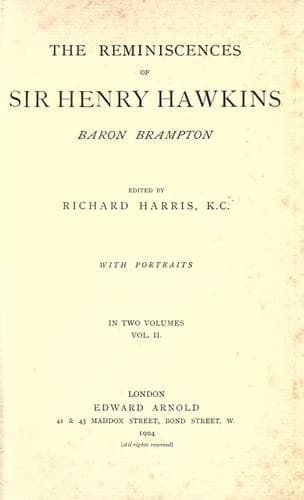
The Reminiscences of Sir Henry Hawkins (Baron Brampton)Brampton, Henry Hawkins, Baron
History
The Reminiscences of Sir Henry Hawkins (Baron Brampton)
Brampton, Henry Hawkins, Baron
Brampton, Henry Hawkins, Baron, 1817-1907; Judges -- Great Britain -- Biography
"Now it's coming," I thought; "he's going to knock me off my wine." I
thought, however, I would be equal to the occasion, and said,--
"I know what you are driving at: you want to know if I ever mix a
little water in my wine."
"No, no, I don't," said he; "you are quite wrong, for if your water is
good and your wine bad, you spoil your water; and if your wine is good
and your water bad, you spoil your wine."
I took his advice--which was certainly worth the fee--and never mixed
my wine with water after that, although I have some doubt as to
whether I had ever done so before.
I came away in good heart, because I was so delighted that there was
not a vestige of anything the matter with me.
With a view to enable me to give each case due consideration before
fixing the poor wretch's doom after conviction, I invariably ordered
the prisoner to stand down until all were tried.
I then spent a night in going through my notes in each case, so that
if there were any circumstances that I could lay hold of by way of
mitigation of the sentence, I did so.
I do not mean to say that I did this in trifling cases, such as a
magistrate could dispose of, but in all cases of magnitude possibly
involving penal servitude.
Once, however, I had made up my mind as to what was, in accordance
with my judgment, the sentence to be passed, I took care never to
alter it upon any plea in mitigation whatever.
For this line of conduct I had the example of Sir Thomas Wilde, when,
as Lord Chief Justice of the Court of Common Pleas, he travelled the
Home Circuit. He was a marvellous and powerful judge in dealing with
the facts of a case. He had tried a prisoner for larceny in stealing
from a house a sack of peas. The prisoner's counsel had made for him
a very poor and absurd defence, in which, over and over again, he had
reiterated that one pea was very like another pea, and that he would
be a bold man who would swear to the identity of two peas.
This miserable defence made the Lord Chief Justice angry, and he
summed up the case tersely but crushingly to this effect: "Gentlemen,
you have been told by the learned counsel very truly that one pea is
very like another pea, and if the only evidence in this case had been
that one pea had been taken from the house of the prosecutor, and a
similar pea had been found in the prisoners house, I for one should
have said it would have been insufficient evidence to justify the
accusation that the prisoner had taken it.
Public-domain text, read in full here on John Shaqi.
Reviews
Reviews
No reviews yet
Be the first to share your thoughts on this work.
Elsewhere in the archive
Join the Discussion
Join the discussion
Sign in to leave a comment or review.
Sign InorCreate an account