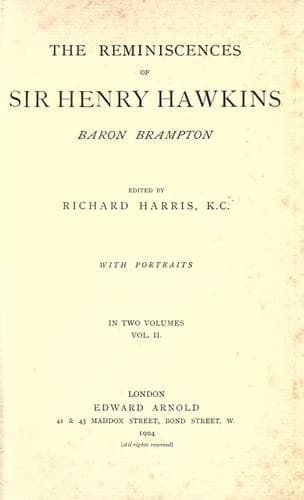
The Reminiscences of Sir Henry Hawkins (Baron Brampton)Brampton, Henry Hawkins, Baron
History
The Reminiscences of Sir Henry Hawkins (Baron Brampton)
Brampton, Henry Hawkins, Baron
Brampton, Henry Hawkins, Baron, 1817-1907; Judges -- Great Britain -- Biography
Well, I had no answer. It is a curious inquisitiveness which it would
do no one any good to gratify. I did not think it necessary to the
happiness of my friends that they should know, and if it would afford
_me_ any satisfaction, it was far better that they should name the
amount than I. They could exaggerate it; I had no wish to do so. It is
true enough in common language I worked hard, but working by system
made it easy. Slovenly work is always hard work; you never get through
it satisfactorily. It was by working easily that I got through so
much. "Never fret" and "_toujours pret_" were my mottoes, as I told
the chaplain; I hope he remembers them to this day. If they would not
help him to a bishopric, nothing would. But I will say seriously that
nothing is so great a help in our daily struggles as _good temper_,
and with that observation I leave my friends still to wonder how I got
through so much.
Judges often talk over their experiences at the Bar. Sometimes I
talked of mine, and on one occasion told the following curious
incident in my long career.
I mention this circumstance as a curiosity only so far as the incident
is concerned, but as more than a curiosity so far as the legality of
evading the substance of the law by a technicality is concerned.
All men are not privileged to cross-examine royalty, and especially
future emperors.
On July 1, 1847, which was not very long after my call to the Bar,
Prince Louis Napoleon, who afterwards became Emperor of the French,
was residing in England.
Of course, in looking back upon a man who afterwards became an
Emperor, the proportions seem to have altered, and he looks greater
than his figure actually was. He is more important in one's eyes, and
therefore from this point of view the event seems to be of greater
magnitude than the mere police-court business that it was. When a man
becomes great, the smallest details of his career increase in value
and importance.
The Prince had given a man of the name of Charles Pollard into custody
for stealing and obtaining by fraud two bills of exchange for £1,000
each.
I was instructed by one Saul (not of Tarsus) to defend, and old Saul
thought it would be judicious to cross-examine the Prince into a
cocked hat, little dreaming what kind of a cocked hat our opponent
would one day wear.
But Saul, not content with this ordinary drum-beating kind of Old
Bailey performance, in which there is much more alarm than harm,
instructed me to make a few inquiries as to the Prince's private life,
and so _show him up_ in public. Saul loved that kind of persecution.
To him the witness-box was a pillory, notwithstanding there was
more mud attaching to the throwers than to the mere object of their
attention.
Public-domain text, read in full here on John Shaqi.
Reviews
Reviews
No reviews yet
Be the first to share your thoughts on this work.
Elsewhere in the archive
Join the Discussion
Join the discussion
Sign in to leave a comment or review.
Sign InorCreate an account