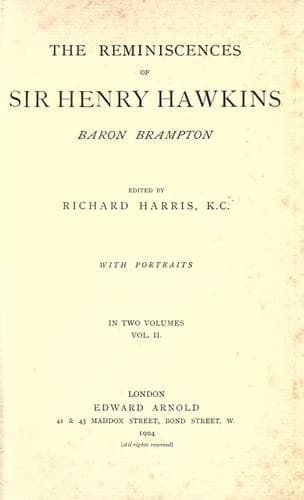
The Reminiscences of Sir Henry Hawkins (Baron Brampton)Brampton, Henry Hawkins, Baron
History
The Reminiscences of Sir Henry Hawkins (Baron Brampton)
Brampton, Henry Hawkins, Baron
Brampton, Henry Hawkins, Baron, 1817-1907; Judges -- Great Britain -- Biography
His surprise, therefore, must have been as great as his chagrin when,
the very night of the decision which unseated him, he came forward
once more as a candidate. The petition had increased his popularity,
and he won the seat with the greatest ease, and without any subsequent
disturbance by the former petitioner.
I have told you of a curious trial before a Recorder of Saffron
Walden, and my memory of that event reminds me of another which took
place in that same abode of learning and justice. Joseph Brown, Q.C.,
and Thomas Chambers, Q.C., were brother Benchers of mine, and when we
met at the Parliament Chamber after dinner it was more than likely
that many stories would be told, for we often fought our battles over
again.
At the time I speak of Knox was the Recorder of that important
borough, and was possessed of all the dignity which so enhances a
great officer in the eyes of the public, whether he be the most modest
of beadles in beadledom, or the highest Recorder in Christendom. To
give himself a greater air of importance, Knox always carried a _blue
umbrella_ of a most blazing grandeur. He was looked up to, of course,
at Saffron Walden, as their greatest man, especially as he occupied
the best apartments at the chief brimstone shop in the town. When I
say _brimstone_, I mean that it seemed to be its leading article;
for there were a great many yellow placards all over and about the
emporium, which, perhaps, ought to have been called a "general shop."
There were three men up before Knox for stealing malt; a very serious
offence indeed in Saffron Walden, where malt was almost regarded as a
sacred object--until it got into the beer.
"Tom" Chambers (afterwards Recorder of London) was defending these
prisoners, and I have no doubt, from the conduct of Knox, acquired a
great deal of that discrimination of character which afterwards so
distinguished him in the City of London. The degrees of guilt in these
persons ought to be noted by all persons who hold, or hope to hold, a
judicial position. As to the first man, the actual thief, there could
be no doubt about his crime, for he was actually wheeling the two or
three shovelfuls of malt in a barrow; so there was not much use in
defending him.
About the second man there was not the same degree of certainty, for
he had never touched the malt or the barrow, and there was no evidence
that he knew the first man had stolen it. The only suspicion--for
it was nothing more--against him was that he was seen to be walking
_along the highway_ near the man who was wheeling the barrow, and as
it was daytime, many others were equally guilty.
The third man was still less implicated, for all that appeared against
him was that _at some time or other_ he had been seen, either on the
day of the theft or just before, to be in a public-house with the
thief and asking him to have a drink.
Public-domain text, read in full here on John Shaqi.
Reviews
Reviews
No reviews yet
Be the first to share your thoughts on this work.
Elsewhere in the archive
Join the Discussion
Join the discussion
Sign in to leave a comment or review.
Sign InorCreate an account