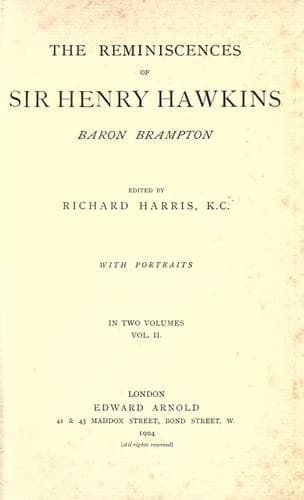
The Reminiscences of Sir Henry Hawkins (Baron Brampton)Brampton, Henry Hawkins, Baron
History
The Reminiscences of Sir Henry Hawkins (Baron Brampton)
Brampton, Henry Hawkins, Baron
Brampton, Henry Hawkins, Baron, 1817-1907; Judges -- Great Britain -- Biography
I should like to make an observation on the recent Act for enabling
prisoners to go into the witness-box and subject themselves, after
giving their evidence, to cross-examination.
It must be apparent to every one, learned and unlearned in its
mysteries, that no evidence can be of its highest value, and often is
of no value, until sifted by cross-examination. I was always opposed
to this process as against an accused person, because I know how
difficult it is under the most favourable circumstances to avoid the
pitfalls which a clever and artistic cross-examiner may dig for the
unwary.
It did not occur to me in that early stage of the discussion on the
Bill that a really true story _cannot_ be shaken in cross-examination,
and that only the _false_ must give way beneath its searching effect.
I had to learn something in advocacy; indeed, I was always learning,
and the best of us may go on for ever learning, as long as this
wonderful and mysterious human nature exists.
However, I am not writing philosophical essays, but relating the facts
of my simple life, and I confess that the case that came before me on
this occasion totally upset my quiet repose in all the comfortable
traditions of the past. Human nature had something which I had not
seen: it arose in this way. A doctor was accused of a terrible
crime against a female patient. I need not give its details; it
is sufficient to say that if the girl's statement was true penal
servitude for life was not too much, for he was a villain of the very
worst character. Taking the ordinary run of evidence, if I may use the
word, and the ordinary mode of cross-examination, which, in the
hands of unskilled practitioners, generally tends to corroborate the
evidence-in-chief, the case was overwhelmingly proved, and how sad and
painful it was to contemplate none can realize who do not understand
anything below the surface of human existence.
I had watched the case with the anxious care that I am conscious
should be exercised in all inquiries, and especially criminal
inquiries, that come before one. I watched, and, let me say,
_especially watched_, for any point in the evidence on which I could
put a question in the prisoner's favour.
Upon that subject I never wavered throughout the whole of my career,
and the testimony of the letters which I received from the most
distinguished members of the criminal Bar--not to say that they are
not equally distinguished in the civil--will, I am sure, bear out my
little self-praise upon a small matter of infinite importance.
Everything in this case seemed to be overwhelmingly against the
unhappy doctor. No one in court, except himself, _could_ believe on
the evidence but that he was guilty.
I, who through my whole life had been studying evidence and the mode
in which it was delivered, believed in the man's guilt, and felt that
no cross-examination, however subtle and skilfully conducted, could
shake it.
Public-domain text, read in full here on John Shaqi.
Reviews
Reviews
No reviews yet
Be the first to share your thoughts on this work.
Elsewhere in the archive
Join the Discussion
Join the discussion
Sign in to leave a comment or review.
Sign InorCreate an account