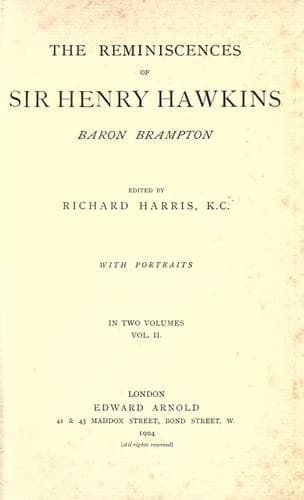
The Reminiscences of Sir Henry Hawkins (Baron Brampton)Brampton, Henry Hawkins, Baron
History
The Reminiscences of Sir Henry Hawkins (Baron Brampton)
Brampton, Henry Hawkins, Baron
Brampton, Henry Hawkins, Baron, 1817-1907; Judges -- Great Britain -- Biography
Counsel suggested that it was never intended by those who placed the
coins where they were found that they should remain there till the end
of time; they were intended, said he, to be taken away by somebody,
but by whom was not indicated by the depositors, and as no time or
person was mentioned, they must belong to the first finder. It was all
a mere chance as to the time of their resurrection. Further, it was
certain they were not intended to be taken by their owners who had
placed them there--they never expected to see them again--but by any
one who happened to come upon them. Those who deposited them where
they were found parted not only with the possession, but with all
claims of ownership. Nor could any one representing him make any
claim.
All this was excellent reasoning as far as it went, and the only thing
the prosecution alleged by way of answer was that they were intended
to be brought to light as antiquities.
"Very well," said the prisoner's counsel; "then there is no felonious
intent in that case--it is merely a mistake. Antiquity came too soon."
And so did the conviction.
I was instructed, with the Hon. George Denman, son of my old friend,
whom I have so often mentioned, to defend three persons at the
Maidstone Assizes for a cruel murder. Mr. Justice Wightman was the
Judge, and there was not a better Judge of evidence than he, or of law
either.
The prisoners were father, mother, and son, and the deceased was a
poor servant girl who had been engaged to be married to another son of
the male prisoner and his wife.
The unfortunate girl had left her service at Gravesend, and gone to
this family on a visit. The prisoners, there could be no doubt, were
open to the gravest suspicion, but how far each was concerned with the
actual murder was uncertain, and possibly could never be proved.
The night before the trial the attorney who acted for the accused
persons called on me, and asked this extraordinary question,--
"Could you secure the acquittal of the father and the son if the woman
will plead guilty?"
It is impossible to conceive the amount of resolution and
self-sacrifice involved in this attempt to save the life of her
husband and son. It was too startling a proposal to listen to. I
could advise no client to plead guilty to wilful murder. It was so
extraordinary a proposition, look at it from whatever point I might,
that it was perfectly impossible to advise such a course. I asked him
if the woman knew what she was doing, and that if she pleaded guilty
certain death would follow.
"Oh yes," said he; "she is quite prepared."
"The murder," I said, "is one of the worst that can be
conceived--cruel and fiendish."
He agreed, but persisted that she was perfectly willing to sacrifice
her own life if her husband and son could be saved.
This woman, so full of feeling for her own family, had thought so
little of that of others that she had held down the poor servant girl
in bed while her son strangled her.
Public-domain text, read in full here on John Shaqi.
Reviews
Reviews
No reviews yet
Be the first to share your thoughts on this work.
Elsewhere in the archive
Join the Discussion
Join the discussion
Sign in to leave a comment or review.
Sign InorCreate an account