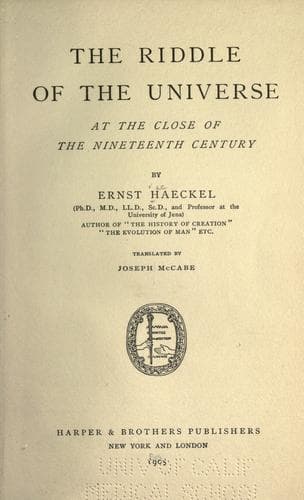
The Riddle of the Universe at the close of the nineteenth centuryHaeckel, Ernst
Religion
The Riddle of the Universe at the close of the nineteenth century
Haeckel, Ernst
Evolution; Monism; Religion and science; Soul
Geologists distinguish three great epochs in the organic history of
the earth, as far as we can read it in the monuments of the science of
fossils--the primary, secondary, and tertiary epochs. According to a
recent calculation, the first occupied at least thirty-four million,
the second eleven million, and the third three million years. The
history of the family of vertebrates, from which our own race has
sprung, unfolds clearly before our eyes during this long period. Three
different stages in the evolution of the vertebrate correspond to the
three epochs; the _fishes_ characterized the primary (palæozoic) age,
the _reptiles_ the secondary (mesozoic), and the _mammals_ the tertiary
(cænozoic). Of the three groups the fishes rank lowest in organization,
the reptiles come next, and the mammals take the highest place. We
find, on nearer examination of the history of the three classes, that
their various orders and families also advanced progressively during
the three epochs towards a higher stage of perfection. May we consider
this progressive development as the outcome of a conscious design or
a moral order of the universe? Certainly not. The theory of selection
teaches us that this organic progress, like the earlier organic
differentiation, is an inevitable consequence of the struggle for
existence. Thousands of beautiful and remarkable species of animals and
plants have perished during those forty-eight million years, to give
place to stronger competitors, and the victors in this struggle for
life were not always the noblest or most perfect forms in a moral sense.
It has been just the same with the history of humanity. The splendid
civilization of classical antiquity perished because Christianity,
with its faith in a loving God and its hope of a better life beyond
the grave, gave a fresh, strong impetus to the soaring human mind. The
Papal Church quickly degenerated into a pitiful caricature of real
Christianity, and ruthlessly scattered the treasures of knowledge
which the Hellenic philosophy had gathered; it gained the dominion
of the world through the ignorance of the credulous masses. In time
the Reformation broke the chains of this mental slavery, and assisted
reason to secure its right once more. But in the new, as in the
older, period the great struggle for existence went on in its eternal
fluctuation, with no trace of a moral order.
Public-domain text, read in full here on John Shaqi.
Reviews
Reviews
No reviews yet
Be the first to share your thoughts on this work.
Elsewhere in the archive
Join the Discussion
Join the discussion
Sign in to leave a comment or review.
Sign InorCreate an account