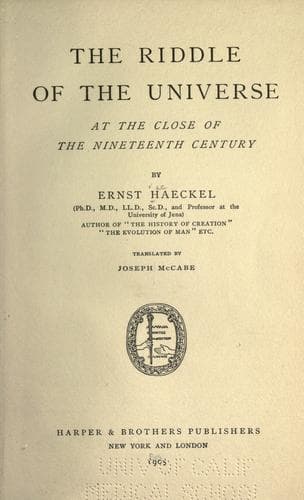
The Riddle of the Universe at the close of the nineteenth centuryHaeckel, Ernst
Religion
The Riddle of the Universe at the close of the nineteenth century
Haeckel, Ernst
Evolution; Monism; Religion and science; Soul
Under the title of _mixotheism_ we may embrace all the forms of
theistic belief which contain mixtures of religious notions of
different, sometimes contradictory, kinds. In theory this most widely
diffused type of religion is not recognized at all; in the concrete
it is the most important and most notable of all. The vast majority
of men who have religious opinions have always been, and still are,
_mixotheists_; their idea of God is picturesquely compounded from the
impressions received in childhood from their own sect, and a number
of other impressions which are received later on, from contact with
members of other religions, and which modify the earlier notions. In
educated people there is also sometimes the modifying influence of
philosophic studies in maturer years, and especially the unprejudiced
study of natural phenomena, which reveals the futility of the theistic
idea. The conflict of these contradictory impressions, which is
very painful to a sensitive soul, and which often remains undecided
throughout life, clearly shows the immense power of the _heredity_ of
ancient myths on the one hand and the early _adaptation_ to erroneous
dogmas on the other. The particular faith in which the child has been
brought up generally remains in power, unless a "conversion" takes
place subsequently, owing to the stronger influence of some other
religion. But even in this supersession of one faith by another the new
name, like the old one, proves to be merely an outward label covering
a mixture of the most diverse opinions and errors. The greater part
of those who call themselves Christians are not monotheists (as they
think), but amphitheists, triplotheists, or polytheists. And the same
must be said of Islam and Mosaism, and other monotheistic religions.
Everywhere we find associated with the original idea of a "sole and
triune God" later beliefs in a number of subordinate deities--angels,
devils, saints, etc.--a picturesque assortment of the most diverse
theistic forms.
Public-domain text, read in full here on John Shaqi.
Reviews
Reviews
No reviews yet
Be the first to share your thoughts on this work.
Elsewhere in the archive
Join the Discussion
Join the discussion
Sign in to leave a comment or review.
Sign InorCreate an account