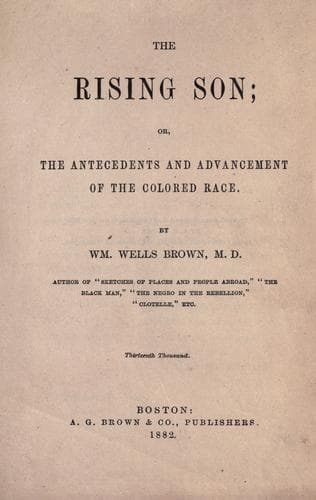
The Rising Son; or, the Antecedents and Advancement of the Colored RaceBrown, William Wells
History
The Rising Son; or, the Antecedents and Advancement of the Colored Race
Brown, William Wells
African Americans -- Biography; African Americans -- History; Black race; Slavery -- United States
The priests, surgeons, and some necessary artisans were preserved from
destruction, consisting in all, of one-tenth of the French residents.
All the rest were massacred without regard to age or sex. The personal
security enjoyed by the foreign whites was no safeguard to the horror
inspired in them by the scenes of misery which were being enacted
without. At every moment of the night, the noise was heard of axes,
which were employed to burst open the doors of the neighboring houses;
of piercing cries, followed by a deathlike silence, soon, however, to
be changed to a renewal of the same sounds of grief and terror, as the
soldiers proceeded from house to house.
When this night of horror and massacre was over, the treacherous
cruelty of Dessalines was not yet appeased. An imperial proclamation
was issued in the morning, alleging that the blacks were sufficiently
avenged upon the French, and inviting all who had escaped the
assassination of the previous night to make their appearance upon
the Place d’Armes of the town, in order to receive certificates of
protection; and it was declared to them that in doing this they might
count upon perfect safety to themselves.
Many hundreds of the French had been forewarned of the massacre, and by
timely concealment had succeeded in preserving their lives. Completely
circumvented by the fiendish cunning of Dessalines, this little remnant
of survivors came out of their places of concealment, and formed
themselves in a body upon the Place d’Armes. But at the moment when
they were anxiously expecting their promised certificates of safety,
the order was given for their execution. The stream of water which
flowed through the town of Cape François was fairly tinged with their
blood.[38]
Many of the great chiefs in the black army were struck with horror
and disgust at this fiendish cruelty of their emperor. Christophe
was shocked at the atrocity of the measure, though he dared not
display any open opposition to the will of the monarch. Dessalines
had no troublesome sensibilities of soul to harass his repose for a
transaction almost without a parallel in history. He sought not to
share the infamy of the action with the subordinate chiefs of his army,
but without a pang of remorse he claimed to himself the whole honor of
the measure.
In another proclamation, given to the world within a few days after
the massacre, he boasts of having shown more than ordinary firmness,
and affects to put his system of policy in opposition to the lenity
of Toussaint, whom he accuses, if not of want of patriotism, at least
of want of firmness in his public conduct. Dessalines was prompted to
the share he took in this transaction by an inborn ferociousness of
character; but a spirit of personal vengeance doubtless had its effect
upon the subordinate agents in the massacre. They hated the French for
the cruelties of Rochambeau.
Public-domain text, read in full here on John Shaqi.
Reviews
Reviews
No reviews yet
Be the first to share your thoughts on this work.
Elsewhere in the archive
Join the Discussion
Join the discussion
Sign in to leave a comment or review.
Sign InorCreate an account