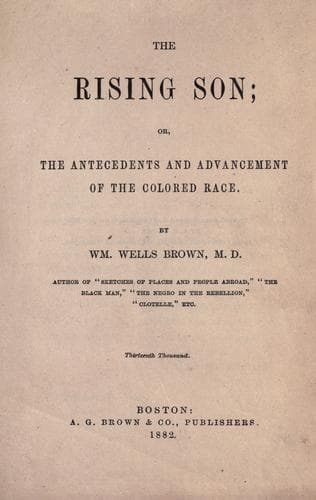
The Rising Son; or, the Antecedents and Advancement of the Colored RaceBrown, William Wells
History
The Rising Son; or, the Antecedents and Advancement of the Colored Race
Brown, William Wells
African Americans -- Biography; African Americans -- History; Black race; Slavery -- United States
But he remained unharmed, though he returned into the house heart-sick
and desperate. A furious onset was immediately commenced from without,
and this was answered by a vigilant and deadly defence from Rigaud’s
followers within. The contest continued through the night, but the mob
were defeated in every attempt which they made to obtain a lodgment
within the walls of the edifice, and no decisive success could be
obtained to disperse them. Rigaud, now convinced that the witchery of
his power existed no longer, made a formal abdication of his authority,
and nominated General Borgella as his successor in the command of
the South. Rigaud, worn with chagrin and humiliation, retired to his
plantation, Laborde, where he died within a few days after, a victim to
the faithlessness of the multitude.
Thus ended the life of André Rigaud, the ablest scholar and most
accomplished military man of any color which the St. Domingo revolution
had produced. The death of Rigaud had the effect of uniting the mulatto
generals, Borgella and Boyer under Pétion, and against Christophe; the
latter, however, succeeded in maintaining his authority in the North,
and still looked forward to a time when he should be able to govern the
whole Island.
Christophe, like Dessalines, had been made a monarch by the
constitution which formed a basis to his power; but he had at
first only assumed to himself the modest title of President. This
moderation in his ambition arose from the desire to supplant Pétion
in his government, and become the supreme head of the whole country
without any rival or associate. For this purpose it was necessary to
surround his power with republican forms; to make it attractive in
the estimation of the better class of blacks and mulattoes, with whom
republican notions happened to be in vogue.
But the prospect of superseding Pétion in his authority had become less
clear with every succeeding attempt, of Christophe against him; and
after years of untiring hostility, it was evident that Pétion was more
firmly enthroned in the hearts of his people than at the commencement
of his administration, and that no solid and durable advantages had
been gained over him in the field. Christophe was thus led to change
his policy; and, instead of seeking to assimilate the nature of the two
governments, in order to supplant his rival in the affections of his
countrymen, he now resolved to make his government the very contrast of
the other, and leave it to the people of his country to decide which of
the two forms of power was the best adapted to the nature and genius of
the population over which they maintained their sway.
The one was a republic in direct contact with the people, and governed
by a plain engineer officer, who, though clothed with the sovereignty
of the state, “bore his faculties so meekly” that he mixed freely with
his fellow-citizens, but as a man in high repute for his intelligence
and his virtues.
Public-domain text, read in full here on John Shaqi.
Reviews
Reviews
No reviews yet
Be the first to share your thoughts on this work.
Elsewhere in the archive
Join the Discussion
Join the discussion
Sign in to leave a comment or review.
Sign InorCreate an account