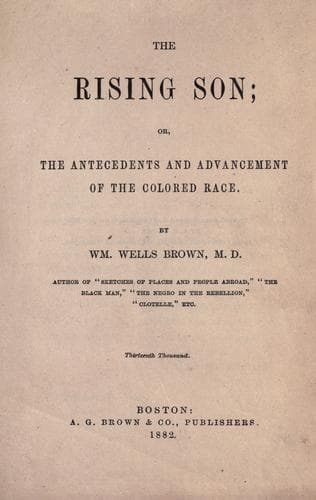
The Rising Son; or, the Antecedents and Advancement of the Colored RaceBrown, William Wells
History
The Rising Son; or, the Antecedents and Advancement of the Colored Race
Brown, William Wells
African Americans -- Biography; African Americans -- History; Black race; Slavery -- United States
A black named Etienne Magny, was one of the ablest of Christophe’s
generals; and though he had been secretary to the council of state that
had raised the latter to the throne of Hayti, he had now become so
dissatisfied with his work that nothing retained him to the standard
of his king but the reflection that his family, whom he had left at
Cape Henry, would be required to pay the forfeit of his defection
with their heads. A body of black soldiers, who were upon the point
of deserting to the army of Pétion, willing to give éclat to their
defection by taking their commander with them, surrounded the tent of
Magny by night, and communicated to him their intention. The black
general hesitated not to express his willingness to accompany them; but
he urged that tenderness for his family forbade an attempt which would
doom them all to certain destruction.
The black soldiers refused to yield to these considerations, and
seizing upon Magny, they bore him off undressed, and without his arms,
into the town. To preserve the lives of Magny’s family, Pétion treated
him as a prisoner of war; and he remained at Port au Prince until the
death of Christophe, when he was made the commander of the North under
Boyer.
Christophe, discouraged at his defeats, and enraged at the sweeping
defections which were every day diminishing the numbers of his army,
and strengthening the resources of his rival, now commenced his retreat
towards the north, whence intelligence had lately reached him of
designs in preparation against him among his own subjects. The army
of the republic, under General Boyer, commenced a pursuit. The cause
of Pétion seemed triumphant. Boyer pressed closely upon the rear of
the royal army, and Christophe seemed on the point of losing all, when
the cautious policy of Pétion restrained Boyer’s activity, and the
republicans turned back from the pursuit. Christophe had been foiled
in his great effort by Pétion and Borgella, and he now regarded the
mulattoes with a hatred so deep and fiendlike, that nothing would
satisfy the direness of his vengeance but the utter extermination of
that race. A body of mulatto women of the town of Gonaives, who had
sympathized with their brethren of Port au Prince in the struggle
which the latter were maintaining against the power of Christophe, and
with this communion of feeling had made prayers to the Virgin against
the success of their king, became the first victims of the rage of
Christophe against their race.
They were marched out of the town, and all subjected to military
execution, without a distinction in their punishment or consideration
of mercy for their sex. Christophe had long ago resolved to rest the
foundation of his power upon the support of the pure blacks, and he
now determined to make his administration one of ceaseless hatred and
persecution to the mulattoes.
Public-domain text, read in full here on John Shaqi.
Reviews
Reviews
No reviews yet
Be the first to share your thoughts on this work.
Elsewhere in the archive
Join the Discussion
Join the discussion
Sign in to leave a comment or review.
Sign InorCreate an account