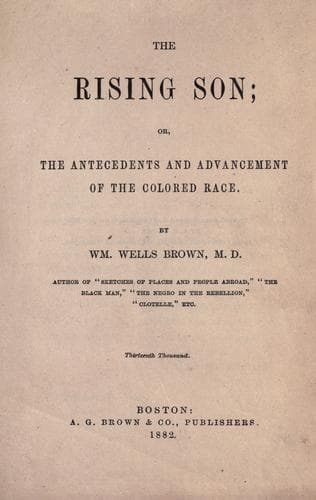
The Rising Son; or, the Antecedents and Advancement of the Colored RaceBrown, William Wells
History
The Rising Son; or, the Antecedents and Advancement of the Colored Race
Brown, William Wells
African Americans -- Biography; African Americans -- History; Black race; Slavery -- United States
Christophe was without education, but like his predecessor, Dessalines,
he found a royal road to learning. His knowledge of books was
extensive, as several educated mulattoes retained about his person
under the name of secretaries were employed several hours of each day
in reading to the monarch. He was particularly delighted with history,
of which his knowledge was extensive and accurate; and Frederick the
Great of Prussia was a personage with whom above all others he was
captivated, the name of Sans Souci, his palace, having been borrowed
from Potsdam.
Such sharpness had been communicated to his genius, naturally astute,
by having knowledge thus dispensed to him in daily portions, that
Christophe became at last a shrewd critic upon the works read before
him, and even grew fastidious in the selection of his authors. The
events of that stormy period of European history, as detailed in the
public journals of the time, were listened to with a greedy ear, and
the course of Napoleon’s policy was watched with a keenness which
manifested Christophe’s own interest in the affair.
Christophe, though a pure African, was not a jet black, his complexion
being rather a dusky brown. His person was commanding, slightly
corpulent, and handsome. His address was cold, polished, and graceful.
He possessed a certain air of native dignity which corresponded well
with his high official station, and he exacted great personal deference
from all who approached him. The personal qualities and majestic
bearing of the black king impressed his own characteristics upon his
court. The most formal ceremony was observed upon public occasions,
and no grandee of the realm could safely appear at the court of
his sovereign without the costume and decorations of his rank. The
ceremonial and observances were modelled after the drawing-rooms at St.
James palace, and Christophe was always pleased with the attendance of
whites, particularly if they were titled Englishmen. Many distinguished
foreigners visited the court of the black monarch, attracted thither
by a curiosity to witness the spectacle of an African levée, a scene
which, by established regulation, was held at the palace on the
Thursday of every week.
The company was collected in an ante-chamber which adjoined the
principal hall of the palace, where the novices in courtly life were
suitably drilled and instructed in the minute details of the parts
they were expected to play in the coming pageantry, by two or three
assistants of the grand master of ceremonies, the Baron de Sicard. When
all things were in readiness, both within and without, the doors were
thrown open, and the monarch of Hayti appeared seated upon the throne
in royal costume, with the crown upon his head, and surrounded by a
glittering cortege composed of his ministers, grand almoner, grand
marshal of the palace, chamberlains, and heralds at arms.
Public-domain text, read in full here on John Shaqi.
Reviews
Reviews
No reviews yet
Be the first to share your thoughts on this work.
Elsewhere in the archive
Join the Discussion
Join the discussion
Sign in to leave a comment or review.
Sign InorCreate an account