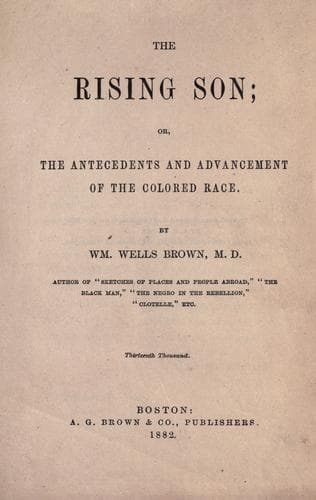
The Rising Son; or, the Antecedents and Advancement of the Colored RaceBrown, William Wells
History
The Rising Son; or, the Antecedents and Advancement of the Colored Race
Brown, William Wells
African Americans -- Biography; African Americans -- History; Black race; Slavery -- United States
The announcement that Pétion was no more threw all the foreign
merchants of the republic into consternation. They expected that
an event like this would be the harbinger of another revolution to
overturn all that had been achieved, or of a long and destructive
anarchy, which would completely annihilate the little authority there
yet remained in the republic. Merchandise to the amount of millions
had been sold to the credit of the country, in the doubtful hope that
its government would be durable. Both treasures and blood were at
stake, but the terror of the moment was soon appeased. At the tidings
of Pétion’s illness, the Senate had assembled itself in session, and
this body conferred power upon the expiring president to nominate his
successor; and Pétion, when he foresaw that his death was inevitable,
designated for this purpose General Boyer, then commanding the
arrondissement of Port au Prince.
The funeral ceremonies of the deceased president took place upon the
first of April, and were performed with the most august solemnity.
All the great officers of the army were ordered to their posts, and
required to maintain a ceaseless vigilance for the preservation of
tranquillity. An embargo was laid until the Sunday following upon all
vessels in the harbor of Port au Prince, and several detachments of
troops were ordered to march towards different points of the frontier.
The observance of every precaution which the most anxious solicitude
could suggest for the maintenance of internal peace, and the prevention
of invasion from abroad, was evidence that Pétion had bequeathed his
power to a successor worthy of his choice.
There was a wide difference between Pétion and Christophe; the former
was a republican at heart, the latter, a tyrant by nature. Assuming
no pretensions to personal or official dignity, and totally rejecting
all the ceremonial of a court, it was Pétion’s ambition to maintain
the exterior of a plain republican magistrate. Clad in the white linen
undress of the country, and with a Madras handkerchief tied about his
head, he mixed freely and promiscuously with his fellow-citizens, or
seated himself in the piazza of the government house, accessible to all.
Pétion was subtle, cautious, and designing. He aspired to be the
Washington, as Christophe was deemed the Bonaparte, of Hayti. By
insinuating the doctrines of equality and republicanism, Pétion
succeeded in governing, with but ten thousand mulattoes, a population
of more than two hundred thousand blacks.
Public-domain text, read in full here on John Shaqi.
Reviews
Reviews
No reviews yet
Be the first to share your thoughts on this work.
Elsewhere in the archive
Join the Discussion
Join the discussion
Sign in to leave a comment or review.
Sign InorCreate an account