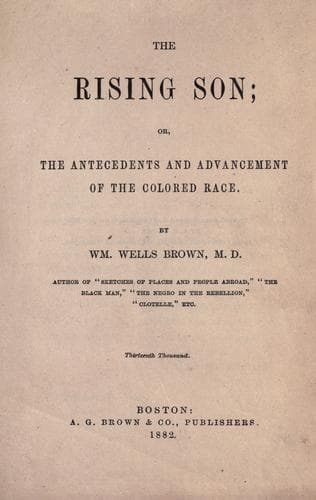
The Rising Son; or, the Antecedents and Advancement of the Colored RaceBrown, William Wells
History
The Rising Son; or, the Antecedents and Advancement of the Colored Race
Brown, William Wells
African Americans -- Biography; African Americans -- History; Black race; Slavery -- United States
“Their good deeds have been consecrated only in their memories, or
lived but to claim a passing notice on the page of the historian. Yet,
who more than they deserve the thanks of the country, and the gratitude
of succeeding generations? Who rallied with more alacrity in response
to the summons of danger? Who endured more cheerfully the hardships of
the camp, or faced with greater courage the perils of the fight? If,
in that hazardous hour, when our homes were menaced with the horrors
of war, we did not disdain to call upon the colored population to
assist in repelling the invading horde, we should not, when the danger
is past, refuse to permit them to unite with us in celebrating the
glorious event which they helped to make so memorable an epoch in our
history. We were not too exalted to mingle with them in the affray;
they were not too humble to join in our rejoicings.
“Such, we think, is the universal opinion of our citizens. We conversed
with many yesterday, and without exception, they expressed approval of
the invitation which had been extended to the colored veterans to take
part in the ceremonies of the day, and gratification at seeing them in
a conspicuous place in the procession.
“The respectability of their appearance, and the modesty of their
demeanor, made an impression on every observer and elicited unqualified
approbation. Indeed, though in saying so we do not mean disrespect
to any one else, we think that they constituted decidedly the most
interesting portion of the pageant, as they certainly attracted the
most attention.”
On Lakes Erie and Champlain, colored men were also engaged in these
battles which have become historical, exhibiting the same heroism that
characterized them in all their previous efforts in defence of their
country’s rights.
FOOTNOTE:
[50] Niles’ Register, Vol. VII., p. 205.
CHAPTER XXXV.
THE CURSE OF SLAVERY.
The demoralization which the institution entailed upon all classes in
the community in which it existed, was indeed fearful to contemplate;
and we may well say that slavery is the curse of curses. While it made
the victim a mere chattel, taking from him every characteristic of
manhood, it degraded the mind of the master, brutalized his feelings,
seared his conscience, and destroyed his moral sense.
Immorality to a great extent, pervaded every slaveholding city, town,
village, and dwelling in the South. Morality and virtue were always the
exceptions. The Southern clergy, backed by the churches, defended their
right to hold slaves to the last. Houses of religious worship and the
negro pen were often in sight of each other.
The Southern newspapers teemed with advertisements, which were a fair
index to this monstrous social evil.
Now that slavery is swept away, it may be interesting to see some
of these newspaper notices, in the light of the new dispensation of
freedom.
Public-domain text, read in full here on John Shaqi.
Reviews
Reviews
No reviews yet
Be the first to share your thoughts on this work.
Elsewhere in the archive
Join the Discussion
Join the discussion
Sign in to leave a comment or review.
Sign InorCreate an account