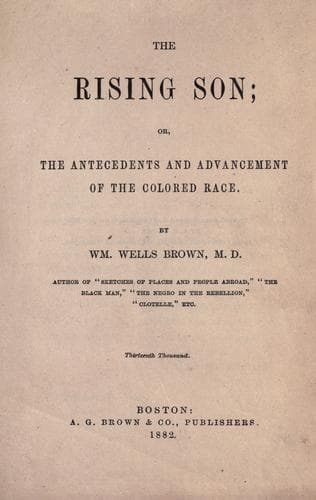
The Rising Son; or, the Antecedents and Advancement of the Colored RaceBrown, William Wells
History
The Rising Son; or, the Antecedents and Advancement of the Colored Race
Brown, William Wells
African Americans -- Biography; African Americans -- History; Black race; Slavery -- United States
Mr. Douglass has obtained a position in the front rank as a lyceum
lecturer. His later addresses from manuscripts, however, do not, in
our opinion, come up to his extemporaneous efforts.
But Frederick Douglass’s abilities as an editor and publisher have done
more for the freedom and elevation of his race than all his platform
appeals. Previous to the year 1848, the colored people of the United
States had no literature. True, the “National Reformer,” the “Mirror
of Liberty,” the “Colored American,” “The Mystery,” the “Disfranchised
American,” the “Ram’s Horn,” and several others of smaller magnitude,
had been in existence, had their run, and ceased to live. All of the
above journals had done something towards raising the black man’s
standard, but they were merely the ploughs breaking up the ground
and getting the soil ready for the seed-time. Newspapers, magazines,
and books published in those days by colored men, were received with
great allowance by the whites, who had always regarded the negro as an
uneducated, inferior race, and who were considered out of their proper
sphere when meddling with literature.
The commencement of the publication of the “North Star” was the
beginning of a new era in the black man’s literature. Mr. Douglass’s
well-earned fame gave his paper at once a place with the first journals
in the country; and he drew around him a corps of contributors and
correspondents from Europe, as well as all parts of America and the
West Indies, that made its columns rich with the current news of the
world.
While the “North Star” became a welcome visitor to the homes of whites
who had never before read a newspaper edited by a colored man, its
proprietor became still more popular as a speaker in every State in
the Union where abolitionism was tolerated.
“My Bondage and My Freedom,” a work published by Mr. Douglass a few
years ago, besides giving a fresh impulse to anti-slavery literature,
showed upon its pages the untiring industry of the ripe scholar.
Some time during the year 1850, we believe, his journal assumed the
name of “Frederick Douglass’s Paper.” Its purpose and aim was the same,
and it remained the representative of the negro till it closed its
career, which was not until the abolition of slavery.
Of all his labors, however, we regard Mr. Douglass’s efforts as
publisher and editor as most useful to his race. For sixteen years,
against much opposition, single-handed and alone, he demonstrated the
fact that the American colored man was equal to the white in conducting
a useful and popular journal.
ALEXANDER W. WAYMAN.
Public-domain text, read in full here on John Shaqi.
Reviews
Reviews
No reviews yet
Be the first to share your thoughts on this work.
Elsewhere in the archive
Join the Discussion
Join the discussion
Sign in to leave a comment or review.
Sign InorCreate an account