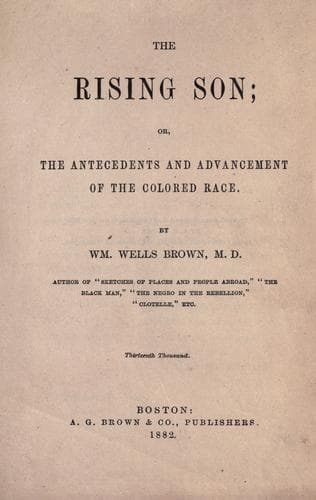
The Rising Son; or, the Antecedents and Advancement of the Colored RaceBrown, William Wells
History
The Rising Son; or, the Antecedents and Advancement of the Colored Race
Brown, William Wells
African Americans -- Biography; African Americans -- History; Black race; Slavery -- United States
“Whenever emancipation shall take place, immediate though it be,
the subjects of it, like many who now make up the so-called free
population, will be in what geologists call the ‘transition state.’
The prejudice now felt against them for bearing on their persons the
brand of slaves, cannot die out immediately. Severe trials will still
be their portion: the curse of a ‘taunted race’ must be expiated by
almost miraculous proofs of advancement; and some of these miracles
must be antecedent to the great day of jubilee. To fight the battle
upon the bare ground of abstract principles will fail to give us
complete victory. The subterfuges of pro-slavery selfishness must now
be dragged to light, and the last weak argument, that the negro can
never contribute anything to advance the national character, ‘nailed
to the counter as base coin.’ To the conquering of the difficulties
heaped up in the path of his industry, the free colored man of the
North has pledged himself. Already he sees, springing into growth,
from out his foster work-school, intelligent young laborers, competent
to enrich the world with necessary products; industrious citizens,
contributing their proportion to aid on the advancing civilization of
the country; self-providing artisans, vindicating their people from the
never-ceasing charge of fitness for servile positions.”
In the “Autographs for Freedom,” from which the above extract is taken,
Professor Reason has a beautiful poem, entitled “Hope and Confidence,”
which, in point of originality and nicety of composition, deserves a
place among the best productions of Wordsworth.
A poem signifies design, method, harmony, and therefore consistency of
parts. A man may be gifted with the most vividly ideal nature; he may
shoot from his brain some blazing poetic thought or imagery, which may
arouse wonder and admiration, as a comet does; and yet he may have no
constructiveness, without which the materials of poetry are only so
many glittering fractions. A poem can never be tested by its length or
brevity, but by the adaptation of its parts. A complete poem is the
architecture of thought and language. It requires artistic skill to
chisel rough blocks of marble into as many individual forms of beauty;
but not only skill, but genius, is needed to arrange and harmonize
those forms into the completeness of a Parthenon. A grave popular
error, and one destructive of personal usefulness, and obstructive to
literary progress, is the free-and-easy belief that because a man has
the faculty of investing common things with uncommon ideas, therefore
he can write a poem.
Public-domain text, read in full here on John Shaqi.
Reviews
Reviews
No reviews yet
Be the first to share your thoughts on this work.
Elsewhere in the archive
Join the Discussion
Join the discussion
Sign in to leave a comment or review.
Sign InorCreate an account