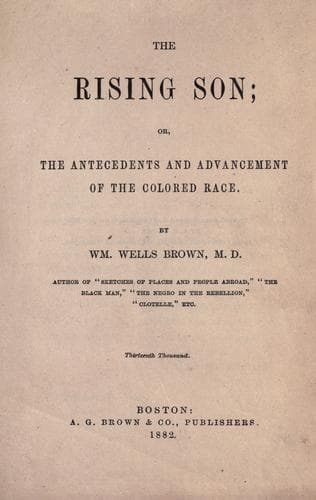
The Rising Son; or, the Antecedents and Advancement of the Colored RaceBrown, William Wells
History
The Rising Son; or, the Antecedents and Advancement of the Colored Race
Brown, William Wells
African Americans -- Biography; African Americans -- History; Black race; Slavery -- United States
His first appearance as a public speaker, was in 1837, in the City of
New York, where his speech at once secured for him a standing among
first-class orators. Dr. Garnett is in every sense of the term a
progressive man. He is a strenuous advocate of freedom, temperance,
education, and the religious, moral, and social elevation of his
race. He is an acceptable preacher, evangelical in his profession.
His discourses, though showing much thought and careful study, are
delivered extemporaneously, and with good effect. Having complete
command of his voice, he uses it with skill, never failing to fill the
largest hall. One of the most noted addresses, ever given by a colored
man in this country was delivered by Dr. Garnett at the National
Convention of Colored Americans, at Buffalo, New York, in 1843.
None but those who heard that speech have the slightest idea of the
tremendous influence which he exercised over the assembly.
Dr. Garnett visited England in 1850, where he spent several months,
and went thence to the island of Jamaica, spending three years there
as a missionary. He has written considerably, and has edited one or
two journals at different times, devoted to the elevation of his race.
Dr. Garnett was, for two or three years, president of Avery College,
where he was considered a man of learning. He also spent some time
in Washington, as pastor of the Presbyterian Church in that city. At
present, he is located over Shiloh Church, New York City.
For forty years an advocate of the rights of his race, forcible and
daring as a speaker, having suffered much, with a good record behind
him, Dr. Garnett may be considered as standing in the front rank as a
leader of his people.
CHARLES L. REMOND.
Born and brought up in Salem, Massachusetts, Mr. Remond had the
advantage of early training in the best of schools. In 1838, he
took the field as a lecturer, under the auspices of the American
Anti-slavery Society, and, in company with the Rev. Ichabod Codding,
canvassed the States of Massachusetts, Rhode Island, and Maine.
In 1840, he visited England as a delegate to the first “World’s
Anti-slavery Convention,” held in London. He remained abroad two years,
lecturing in the various towns in the united kingdom.
Public-domain text, read in full here on John Shaqi.
Reviews
Reviews
No reviews yet
Be the first to share your thoughts on this work.
Elsewhere in the archive
Join the Discussion
Join the discussion
Sign in to leave a comment or review.
Sign InorCreate an account