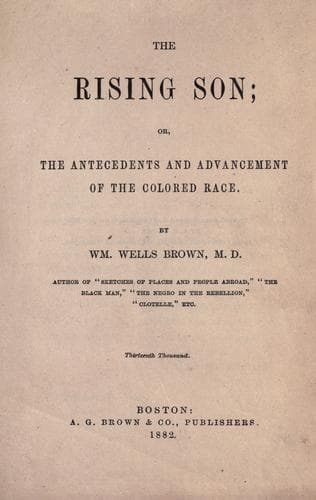
The Rising Son; or, the Antecedents and Advancement of the Colored RaceBrown, William Wells
History
The Rising Son; or, the Antecedents and Advancement of the Colored Race
Brown, William Wells
African Americans -- Biography; African Americans -- History; Black race; Slavery -- United States
Many of the citizens of Boston, New York, Washington, Philadelphia, and
other cities of our country, are often called to mention the names of
their absent or departed friends, by looking upon their features, as
transferred to canvas by the pencil and brush of William H. Simpson,
the young colored artist. He has evidently taken Titian, Murillo, and
Raphael for his masters. The Venetian painters were diligent students
of the nature that was around them. The subject of our sketch seems to
have imbibed their energy, as well as learned to copy the noble example
they left behind. The history of painters, as well as poets, is written
in their works. The best life of Goldsmith is to be found in his poem
of “The Traveller,” and his novel of “The Vicar of Wakefield.” No one
views the beautiful portrait of J. P. Kemble, in the National Gallery
in London, in the character of Hamlet, without thinking of Sir Thomas
Lawrence, who executed it.
The organ of color is prominent in the cranium of Mr. Simpson, and
it is well developed. His portraits are admired for their life-like
appearance, as well as for the fine delineation which characterizes
them all. It is very easy to transcribe the emotions which paintings
awaken, but it is no easy matter to say why a picture is so painted
as that it must awaken certain emotions. Many persons feel art; some
understand it; but few both feel and understand it. Mr. Simpson is
rich in depth of feeling and spiritual beauty. His portrait of John T.
Hilton, which was presented to the Masonic Lodge a few months since, is
a splendid piece of art. The longer you look on the features, the more
the picture looks like real life.
The taste displayed in the coloring of the regalia, and the admirable
perspective of each badge of honor, show great skill. No higher praise
is needed than to say that a gentleman of Boston, distinguished for
his good judgment in the picture gallery, wishing to secure a likeness
of Hon. Charles Sumner, induced the senator to sit to Mr. Simpson
for the portrait; and in this instance the artist has been signally
successful.
His likenesses have been so correct, that he has often been employed
to paint whole families, where only one had been bargained for in
the commencement. He is considered unapproachable in taking juvenile
faces. Mr. Simpson does not aspire to anything in his art beyond
portrait-painting. Nevertheless, a beautiful fancy sketch, hanging in
his studio, representing summer, exhibits marked ability and consummate
genius. The wreath upon the head, with different kinds of grain
interwoven, and the nicety of coloring in each particular kind, causes
those who view it to regard him as master of his profession. Portraits
of his execution are scattered over most of the Northern States and the
Canadas. Some have gone to Liberia, Hayti, and California.
Public-domain text, read in full here on John Shaqi.
Reviews
Reviews
No reviews yet
Be the first to share your thoughts on this work.
Elsewhere in the archive
Join the Discussion
Join the discussion
Sign in to leave a comment or review.
Sign InorCreate an account