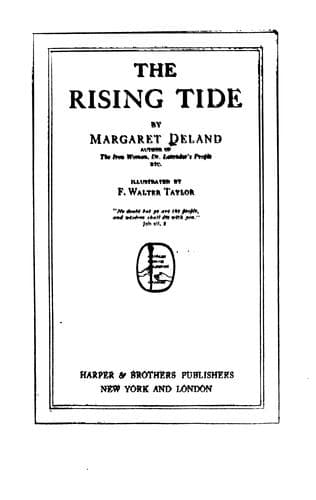
Mate selection -- Fiction; Women -- Suffrage -- United States -- Fiction; Young women -- Fiction
"I've got to go to a league meeting," she excused herself. When she had
gone and he was standing with his back to the fire, sipping his tea and
talking pleasantly of the weather, or the barber's children, or poor
Flora's tendency to put too much starch in the table linen (raising his
voice, in a matter-of-fact way, when there was a noise behind the door
of the other room), he agreed warmly with Mrs. Payton's tribute to her
daughter: "Freddy is getting companionable."
"Indeed she is!" he said, and added that she was remarkably clever
about puzzles--which pleased Mrs. Payton very much. This new sense of
sympathy which held Fred down to picture puzzles, made her try to avoid
topics on which she knew she and her mother could not agree. As the
winter went on, the especial topic to be avoided was a strike among the
rubber workers. Fred was passionately for the strikers, who were all
girls. She went constantly to Hazelton, where the factory was, to give
what help she could to the union women, and to admonish them that the
way to cure industrial conditions, which all fair-minded people admitted
were frightful, was by the ballot.
"Get the man's ballot, and you'll get the man's wages!" was her
slogan--and she was quite fierce with her man of business when he
pointed out the economic fallacy of her words.
"The kingdom of God cometh not by the ballot," he admonished her.
"I feel as if I were going to Sunday-school!"
"A little Sunday-school wouldn't hurt you. It never seems to strike
you," he ruminated, "that if 'laws,' which you are so anxious to have a
hand in making, could settle supply and demand, the men, poor creatures,
would have feathered their own nests a little better."
To which Miss Payton replied, concisely, "Rot!"--and continued to tell
the strikers that suffrage was a cure-all.
It was in March that one of the morning papers announced, with snobbish
detail, that Miss Freddy Payton, a "young society girl," had "patrolled"
to keep off scabs. That evening, at dinner, Mrs. Payton, mortified to
death at the notoriety, and encouraged by Arthur Weston's presence at
the table, ventured into controversy:
"When I was a young lady--" she began, and instantly Frederica's lance
was in rest! She did not mean to be cruel--but she couldn't help being
smart. Her mother's injured sense of propriety was batted back to her
across the dinner-table, like a shuttlecock from a resounding
battledore.
"You may say what you like," Mrs. Payton said, obstinately, "but I don't
believe it would make a bit of difference to give those perfectly
uneducated Italian girls a vote. It hasn't," she ended, with one of
those flashes of shrewdness so characteristic of dull women, "made any
difference in the men's wages. And, anyhow, I don't understand why you
like to mix yourself up with all sorts of persons."
"The Founder of your religion mixed Himself with all sorts of persons,"
Frederica said, wickedly; "but, of course, He would not be in society
to-day."
Public-domain text, read in full here on John Shaqi.
Reviews
Reviews
No reviews yet
Be the first to share your thoughts on this work.
Elsewhere in the archive
Join the Discussion
Join the discussion
Sign in to leave a comment or review.
Sign InorCreate an account