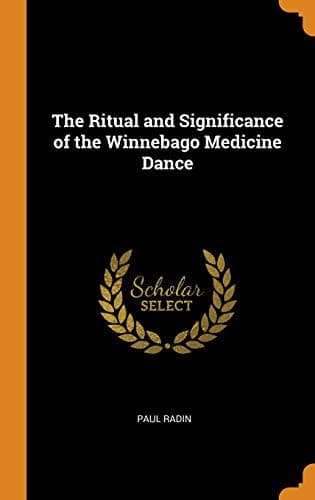
The ritual and significance of the Winnebago medicine danceRadin, Paul
Religion
The ritual and significance of the Winnebago medicine dance
Radin, Paul
Thesis (Ph. D.); Winnebago Indians -- Rites and ceremonies
5. _Medicine Dance._—The Medicine Dance, looked upon in its entirety,
is composed of a long course of preparation (now discontinued), the
Four Nights’ Preparation, the sweat-bath ceremony, the night and the
day divisions of the general ceremony, and the secret brush ceremony.
These ceremonies have all become amalgamated into a more or less firm
unit, whose individual characteristics we have touched upon before.
The society is known in Winnebago as _Mañkaⁿ′ni_, the word _mañkaⁿ′_,
meaning “medicine” in its medicinal aspect, as opposed to _wasê′_,
meaning “medicine” in its magical aspect. As far as can be seen from
a detailed study of the rituals, no prominence seems, however, to be
given to the therapeutic or herbalist aspect. There are, it is true,
medicines for general therapeutic practice and for hunting, fishing,
love, and especially for “bad” purposes. But in the ceremony as given
to-day, and as described by those well versed in the ritual of the
society, these medicines find no place.
There is, however, a very persistent exoteric interpretation of
the Medicine Dance, according to which the members are regarded
primarily as powerful shamans concerned preferably with the practice
of “bad” magic. In this practice they are greatly aided by the fact
that their membership in the society increases their magical powers,
especially that connected with the ability to transform themselves
into all kinds of animate and inanimate objects for the furtherance
of their evil designs. The most feared shamans—those who are
distinguished from all others by the possession of the iron moccasins
(_maⁿzua′gudjê_)—belonged to this society. This exoteric interpretation
does not, however, seem to tally with the designation _mankaⁿ′ni_.
Personally I think this term is a popular one, and has no real
significance as a characterization of the functions of the society,
at least to-day. This exoteric interpretation is in all probability
true to a certain extent. It would, however, be essential to determine
whether these shamanistic powers are characteristic of members as
individuals, and only secondarily connected with them as members of the
society, before we can properly understand their significance. That
membership was connected in any way with an increase of shamanistic
powers, is certainly improbable. These powers are unquestionably
identical with the general shamanistic and magical practices mentioned
previously in the Shell and Pebble Societies.
In other words, the general shamanistic and magical beliefs of the
tribe are found present in this society, as they are found in other
societies.
What would tend to minimize our considering these features as in any
way significant of the Medicine Dance, is the fact that there has been
no tendency to develop or emphasize any specific aspect of magic, and
that shamanistic practices are absent and appear entirely disassociated
from the society.
Public-domain text, read in full here on John Shaqi.
Reviews
Reviews
No reviews yet
Be the first to share your thoughts on this work.
Join the Discussion
Join the discussion
Sign in to leave a comment or review.
Sign InorCreate an account