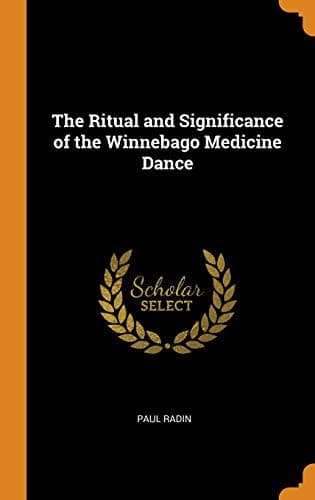
The ritual and significance of the Winnebago medicine danceRadin, Paul
Religion
The ritual and significance of the Winnebago medicine dance
Radin, Paul
Thesis (Ph. D.); Winnebago Indians -- Rites and ceremonies
In Melanesia, for example, women are entirely excluded from the
societies. However, in Melanesia, societies are associated with a
multitude of religious and social functions in which women are not
permitted to participate. In other words, the Melanesians draw the line
of demarcation between the activities of men and women along these
lines. If, for instance, in the New Hebrides, women have nothing to do
with the funeral and mortuary rites, and a secret society is intimately
connected with such rites, then we ought not to be surprised that women
are not admitted into the society. It seems to me, therefore, that we
should make much better progress in our study of this phenomenon in
Melanesia and in Polynesia, if we were first to examine whether either
the conceptions of the tribe, or the nature of the specific society, or
the cultural elements with which it was associated, debarred women from
membership.
A few examples from Africa will emphasize this point even more
forcibly, and at the same time indicate along what lines the respective
spheres of men’s and women’s actions are drawn there. In the Purrah
Society, women are excluded. The society has general war and judicial
functions which do not come within the domain of women, according to
the ideas of the tribe. In the Attonga Society[44] of Senegambia, only
women are admitted, and the society is associated with mortuary rites.
In the Dschengu we have another women society connected here with the
cult of some water deity.[45] In the region around the mouth of the
Ogowe there are a number of powerful women societies associated with
various elements.[46]
If we now proceed to Schurtz’s contention, that women societies are
merely imitations of men’s societies, we shall see that, as a general
statement, this is as unjustified as is his interpretation that the
admission of women into societies is a secondary feature. That it
is true in a number of cases, is unquestioned. However, when, as in
Africa, we see a very strong tendency for the formation of societies,
and see at the same time a very large number of women societies, it
seems far more justifiable to assume that the women societies are
formed in response to the same tendencies as those of men. To judge
from parallels in other parts of the world, it is extremely likely that
women will form societies wherever men show a strong tendency to do so.
A number of factors may, however, interfere with a development of such
societies. For instance, it is quite plausible that where, as among the
Melanesians, a strong society-forming tendency existed, and women did
not participate in it, some strong reason existed which might perhaps
be ascribed to the fact that women do not there participate in those
rites that are almost universally associated with societies.
Public-domain text, read in full here on John Shaqi.
Reviews
Reviews
No reviews yet
Be the first to share your thoughts on this work.
Elsewhere in the archive
Join the Discussion
Join the discussion
Sign in to leave a comment or review.
Sign InorCreate an account