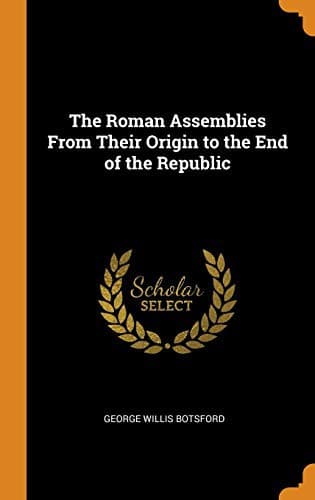
The Roman assemblies from their origin to the end of the RepublicBotsford, George Willis
History
The Roman assemblies from their origin to the end of the Republic
Botsford, George Willis
Constitutional law -- Rome; Rome -- Politics and government
Mommsen[2508] supposes that these jurors were for the quaestio de
maiestate only. For this opinion he depends upon the assertion of
Cicero[2509] that the equites remained till Sulla’s legislation in
uninterrupted possession of the courts. The authority of Cicero, however,
would allow us to assume that while the equites lost the legal monopoly
they retained practical control. However that may be, it is hardly
possible that this reactionary measure survived the proletarian uprising
under Marius and Cinna. The lex agraria of the same Plautius seems to
have been intended for supplying the veterans of the Social War with
farms.[2510] The lex Papiria, which introduced the semiuncial _as_, is
doubtless to be assigned to C. Papirius Carbo, the colleague of Plautius
above mentioned. If so, the object was to relieve slightly the financial
embarrassment caused by the war, and more particularly to bring the small
coins of Rome into correspondence with those of Italy.[2511]
IV. _The Political Equalization of Italy_
88-83
With many Italians still in revolt and the others smarting under the
inferior citizenship eked out to them, and with Mithridates threatening
the existence of the empire, Rome should have adopted a policy of
domestic conciliation. Under these circumstances Sulla, consul in 88,
showed a lamentable want of tact in expressing the sentiment that there
could be no peace in Italy as long as a single Samnite lived[2512]—a
curiously antiquated frame of mind for a statesman of his shrewdness.
The cause of the new citizens was taken up by P. Sulpicius Rufus, a
patrician who had forsaken his rank to qualify himself for the plebeian
tribunate.[2513] A man of marvellous eloquence, he had been an adherent
of Drusus, though more inclined to the equestrian interests. As tribune
of the plebs, 88, he seems to have tried to win the support of the senate
and of the equestrian order to his policy; but failing in the attempt,
he looked for aid to the commons and to a small band of knights who were
faithful to him. His rogation contained the following articles: (1)
that the new citizens and the libertini should be distributed among all
the tribes,[2514] with a view to completing the plan of Livius Drusus
for the political equalization of Italy; (2) that those who had been
driven from the state by violence should be recalled.[2515] This article
was probably for the benefit of those knights against whom the Varian
law had been turned.[2516] His rogation provided further, (3) that no
one who owed more than two thousand denarii should be a senator.[2517]
Money was scarce because of the war;[2518] and Sulpicius must have felt
that if the senators, most of whom were abundantly able, should pay
their debts, it would go far toward relieving the stringency, and that
if any were ejected because of failure to pay, an opportunity would be
afforded of promoting equites to the vacant places. The consuls of the
year, L. Cornelius Sulla and Q.
Public-domain text, read in full here on John Shaqi.
Reviews
Reviews
No reviews yet
Be the first to share your thoughts on this work.
Elsewhere in the archive
Join the Discussion
Join the discussion
Sign in to leave a comment or review.
Sign InorCreate an account