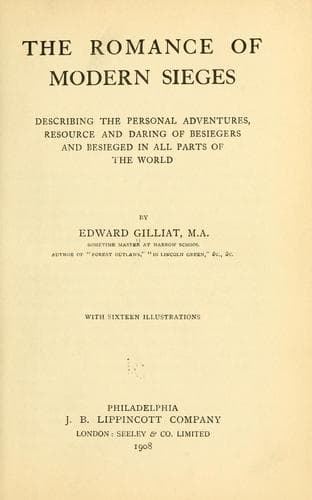
The Romance of Modern Sieges: Describing the personal adventures, resource and daring of besiegers and beseiged in all parts of the worldGilliat, Edward
History
The Romance of Modern Sieges: Describing the personal adventures, resource and daring of besiegers and beseiged in all parts of the world
Gilliat, Edward
Adventure and adventurers; Battles; Sieges; War
This startling news meant that Paris was ready to surrender. How many
hearts were lighter in both camps next day! War is not all glory
and heroic achievement. Those who know what war is pray to God that
statesmen and nations may think twice before they rush into so terrible
a calamity. In this war of 180 days the Germans had won fifteen great
victories, captured twenty-six fortresses, and made 363,000 prisoners.
“Paris is utterly cowed, fairly beaten”--so they said who came from
Paris to the German lines, and a few non-combatants, journalists, and
philanthropists, ventured to enter the city before the German troops
passed in on the 1st of March. They found the streets crowded with
men in uniform. The food shops had nothing to sell. There were a few
sickly preserves, nothing solid worth eating--some horses’ fat for a
delicacy to help down the stuff they called bread. A fowl was priced at
forty-five francs; stickleback were fourteen francs a pound; butter,
forty francs a pound. Outside the bakers’ shops stood a shivering line
of ladies and women, waiting their turn for loaves that tasted like
putty, and pulled to pieces like chopped straw.
But there were in side streets many of the roughest, the most
cowardly and cruel ruffians of the worst parts of Paris. They were on
the prowl, waiting for their prey; so no wonder that Mr. Archibald
Forbes, journalist, and several others in divers parts of the city had
unpleasant experiences.
Forbes tells us he was walking down the Champs Elysées when he met the
Crown Prince of Saxony with his staff riding by. Forbes raised his hat;
the Prince returned the salute and passed on. But the dirty _gamins_
of Paris had been looking on. They hustled the Englishman, called him
_mouchard_ (spy), _sacré Prussien_, _cochon_, tripped him up, hit him
on the back of the head with a stick; then, when he was down, they
jumped on his stomach with their sabots or wooden shoes. He struggled,
as a Scotsman can, got up, hit out right and left; but numbers
prevailed, and he was dragged by the legs on his back, with many bumps
and bruises, to the police-station. There he showed his papers, and
the Prefect released him in a humour that said, “I am mighty glad you
Parisians have had a good thrashing.”
Another journalist--so he told me in London a few weeks later--also had
ventured to stray away from the German sentries in order to see what
Paris thought of a siege. He soon found himself the centre of an angry
throng.
Some cried: “He is a _sacré Prussien_! See his yellow hair!”
“No; I am an English artist,” shouted my friend, still smiling.
“He is a confounded spy! Take him to the Seine! duck him in the river!”
Public-domain text, read in full here on John Shaqi.
Reviews
Reviews
No reviews yet
Be the first to share your thoughts on this work.
Elsewhere in the archive
Join the Discussion
Join the discussion
Sign in to leave a comment or review.
Sign InorCreate an account