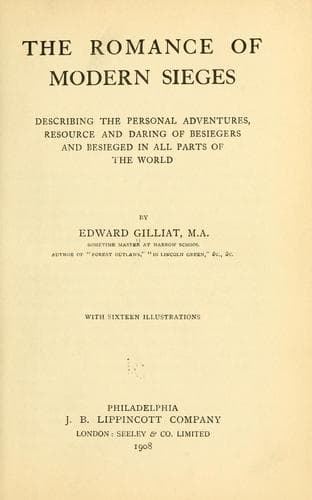
The Romance of Modern Sieges: Describing the personal adventures, resource and daring of besiegers and beseiged in all parts of the worldGilliat, Edward
History
The Romance of Modern Sieges: Describing the personal adventures, resource and daring of besiegers and beseiged in all parts of the world
Gilliat, Edward
Adventure and adventurers; Battles; Sieges; War
“We lit our lanterns,” he says, “and went cautiously into the valley.
There were Prussian sharpshooters in the wood beyond, and I confess I
was very nervous at first: the still night, the errand we were on, all
awed one. But so soon as we reached the outskirts of the battle-field
all personal feelings gave way to others. Here at every turn we found
our aid was wanted. Thousands of dead and wounded were around us, and
we, a few strangers sent by the International Society of London, were
all that were present to help them. Plugging and bandaging such wounds
as were hopeful of cure, giving a life-saving drink here and there,
moving a broken limb into a more easy position, and speaking a word
of encouragement where the heart was failing--this was all we could
do. But all that night each worked his utmost, and when our water
failed two of us walked back four miles to Gravelotte and brought a
bucketful. We can dress, but not remove, the wounded now. Often have
I been tempted to put a poor fellow out of his pain; it seems kinder,
wiser, and more Christian to blow out the flickering lamp than let
it smoulder away in hours of anguish. Daylight begins to dawn, and
we seek carriages--that is, jolting unhung carts--to convey some of
the wounded. Now, as we raise them up and torture their poor wounds
by moving them, for the first time we hear a cry. The groans of the
dying, the shrieks of the wounded, are absent from the battle-field,
but far more dreadful and awe-inspiring is the awful stillness of that
battle-field at night. There is a low, quivering moan floats over
it--nothing more; it is a sound almost too deep for utterance, and it
thrills through one with a strange horror. Hardly a word is uttered,
save only a half-wailed-out cry of ‘Ohé! ma pauvre mère!’ Nothing is
more touching, nothing fills one’s eyes with tears more, than this
plaintive refrain chanted out as a death-chant by so many sons who
never more on this side the grave will see again that longed-for
mother--‘Ohé! ma mère, ma pauvre mère!’
Public-domain text, read in full here on John Shaqi.
Reviews
Reviews
No reviews yet
Be the first to share your thoughts on this work.
Elsewhere in the archive
Join the Discussion
Join the discussion
Sign in to leave a comment or review.
Sign InorCreate an account