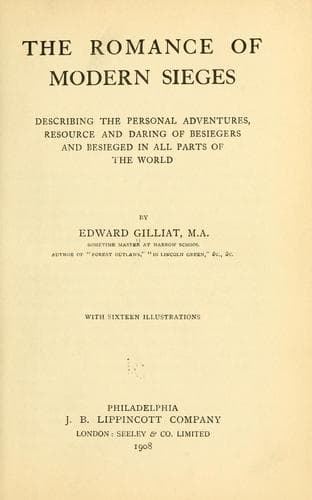
The Romance of Modern Sieges: Describing the personal adventures, resource and daring of besiegers and beseiged in all parts of the worldGilliat, Edward
History
The Romance of Modern Sieges: Describing the personal adventures, resource and daring of besiegers and beseiged in all parts of the world
Gilliat, Edward
Adventure and adventurers; Battles; Sieges; War
One day a _cantinière_ had left her cart full of drinkables just
outside the gate while she went to the fort to ask what was wanted.
She tarried, and her poor horse felt faint, knelt down, and tried to
die. No sooner was the poor beast on his knees than half a score of
soldiers rushed out to save his life by cutting his throat--at least,
it made him eat better. They quickly slipped off his skin and cut him
up in all haste. So many knives were “e’en at him,” they soon carried
off his “meat.” Then, in a merry mood, seeing the gay _cantinière_ was
too busy flirting to attend to her cart, they carefully set to work
and built him up again. They put the bones together neatly, dragged
the hide over the carcass, and arranged the harness to look as if the
animal had lain down between the shafts. Then they retired to watch
the comedy that sprang out of a tragedy. Madame comes bustling out of
the fort. Eh! what’s that? Poor Adolfe is down on the ground! The fat
woman waddles faster to him, calls him by name, taunts him with want
of pluck, scolds, gets out her whip; then is dumb for some seconds,
touches him, cries, weeps, wrings her hands in despair. Sounds of
laughter come to her ears; then she rises majestically to the occasion,
pours out a volley of oaths--oaths of many syllables, oaths that tax a
genius in arithmetic: _diable! cent diables, mille diables, cent mille
diables!_ and so on, until she loses her breath, puts her fat hand
to her heart, and again falls into a pathetic mood, passing later on
into hysteria, and being led away between two gendarmes. Poor madame!
She had loved Adolfe, and would have eaten him in her own home circle
rather than that those _sacrés_ soldiers should filch him away.
Well, they ate horses, when they could get them; but donkeys were even
more delicious, though very rare, for they seldom died, and refused to
get fat. Food was growing so scarce in October that when you went out
to dinner you were expected to take your own bread with you. Potatoes
were sold at fifteen pence a pound; a scraggy fowl might be bought
for thirty shillings. The Prussians had spread nets across the river,
above and below, to prevent the French from catching too many fish. As
for sugar, it rose to seven shillings a pound. Salt was almost beyond
price. The poor horses looked most woebegone. Many of them were Arabs,
their bones nearly through their skin, and they looked at their friends
with such a pitiful, appealing eye that it was most touching. You
might have gone into a trooper’s tent and wondered to see the big tear
rolling slowly down the bronzed cheek of a brave soldier.
Public-domain text, read in full here on John Shaqi.
Reviews
Reviews
No reviews yet
Be the first to share your thoughts on this work.
Elsewhere in the archive
Join the Discussion
Join the discussion
Sign in to leave a comment or review.
Sign InorCreate an account