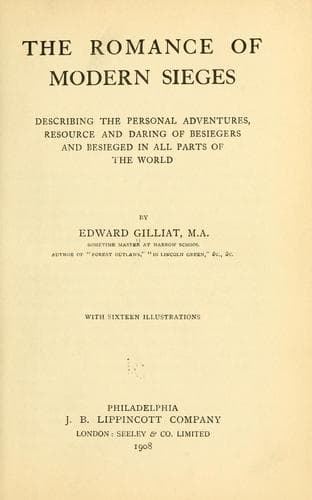
The Romance of Modern Sieges: Describing the personal adventures, resource and daring of besiegers and beseiged in all parts of the worldGilliat, Edward
History
The Romance of Modern Sieges: Describing the personal adventures, resource and daring of besiegers and beseiged in all parts of the world
Gilliat, Edward
Adventure and adventurers; Battles; Sieges; War
“I had some cold coffee left in my flask, which I got my companion to
pour down his throat. He bowed his poor bruised head gratefully, and we
left him to die. The ground was strewn with haversacks, rifles, swords,
wounded men; riderless horses, neighing vehemently, trotted about in
search of food. These sights were revealed to me by the peaceful,
dying golden light of a summer sunset. Even war, that hell-born product
of the iniquity of monarchs and statesmen, receives its quota of
sunshine.”
A few weeks later Herbert was summoned to the Ferik, or General of
Division, and asked if he could speak French well enough to take a
letter into the Russian camp. He said “Yes,” made himself smart in
new tunic and boots, and flattered himself that his tanned, smooth,
youthful face looked well below the bright red fez with its jaunty
tassel, in spite of his chin being still under repair. A corporal
carrying a white flag and a bugler well mounted rode with him. They
were handsome, strapping fellows, in the highest of spirits. After a
ride of six miles they came in sight of a detachment of Cossacks. A
young Russian Lieutenant rode to meet them, waving his handkerchief.
Herbert stated his business in French, was asked to dismount while
awaiting instructions. The Russians crowded round out of curiosity; the
horses were fed and watered, cigarettes were exchanged, and friendly
talk ensued. In half an hour a horseman rode up, and Herbert was bidden
to mount. His eyes were bandaged, his horse was led. After a sharp
trot of twenty minutes they halted, the handkerchief was taken off,
and he found himself in a battery. An officer came up and took the
letter, then handed Herbert over to an infantry Colonel, who took him
into a small tent. Here, with some other officers, they had a cosy
meal--wine, bread, and soup--a pleasant chat and smiles all round. It
was a fortnight since the last battle, and the Russians were still lost
in admiration of the bravery with which the Turks had defended their
positions.
“Vos hommes, mon camarade, sont des diables. Jamais je n’ai vu pareille
chose.”
That was just a glimpse of the enemy, and proved that, though men may
fight by order, they may yet be friends at heart.
Public-domain text, read in full here on John Shaqi.
Reviews
Reviews
No reviews yet
Be the first to share your thoughts on this work.
Elsewhere in the archive
Join the Discussion
Join the discussion
Sign in to leave a comment or review.
Sign InorCreate an account