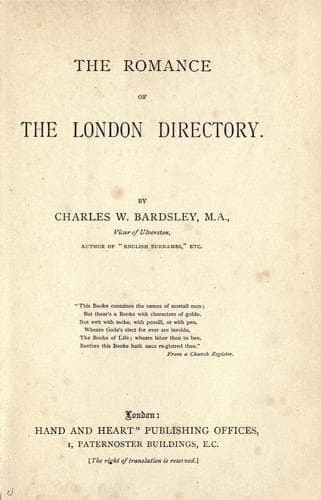
The Romance of the London DirectoryBardsley, Charles Wareing Endell
History
The Romance of the London Directory
Bardsley, Charles Wareing Endell
Names, English -- England -- London; Names, Personal -- England -- London
Knight, like Squire and Bachelor,—all relics of feudal days,—is largely
represented in London. A would-be reader of the poets, it is said, went
into a shop and asked to see a copy of “Young Knight’s Thoughts.” He was
somewhat astonished to find that “Young” was not an adjective, but a
surname. This reminds one of Southey’s story of the lady who, seeing a
book advertised bearing the title “An Essay on Burns,” ordered a copy,
thinking it treated of scalds, and might contain some remedies. Say,
Sayer, Guster, and Taster—the last alone being now obsolete—all refer to
the office mentioned above; the duty of the first bearers of these
several names being to hazard their own lives for the preservation of
their masters’. In a word, they stood behind their lord’s chair, and as
every dish of meat or cup of wine was brought in, they _assayed_ it
(_i.e._, they took the first bite or sup); so that if either had been
“drugged” by some conspirator in the kitchen, the baron might escape. It
is right to add, to prevent misconception, that in some cases our Sayers
owe their origin, like “Tester,” to another officership—that of examining
money, to see whether it was full weight and of genuine metal. There are
four or five “Testers” in the London Directory.
We may close this list with the mention of such surnames as Spencer or
“Spenser”; Marshall, Chamberlain or Chamberlin, Warder, and Butler. All
these represented important officerships.
We may here take the opportunity of referring to the condition of the
lower classes. In the country there was no middle class, such as we know
by the term, excepting those who are represented in the Directory under
the sobriquet of Yeoman, Yeomans, and Yeomanson. The peasantry were
oftentimes little more than goods and chattels of their masters. We must
not exaggerate, however, for although there are sixty-four “Bonds” in the
London Directory, who represent such old entries as “William le Bonde,”
the progenitors of this name were in no such abject servitude as is now
understood by the word. That they were hard worked there can be no
doubt:
“Of alle men in londe
Most toileth the bonde,”—
and how much freedom was valued may be guessed from the number of Franks,
Franklins, Frees, Freebodys, Freemans, Freeds, and Freeborns, in the big
tome we are discussing. We find even Free-wife and Free-woman in the
older registers, but they are now obsolete—in the Directory, I mean, not
in actual life, for very often the wife not merely “rules her house,” but
her husband too, and a good thing for him if he only knew it! There are
fifty-three “Frys” to be added to this list, the old form of “free.” How
curious that the lady who so distinguished herself in toiling for the
abolition of slavery should have borne the name of Elizabeth Fry! Who
strove more earnestly to make the bond free than she? Truly Tom Hood
meant jest for earnest when he wrote his ode to Dr. Kitchener:—
Public-domain text, read in full here on John Shaqi.
Reviews
Reviews
No reviews yet
Be the first to share your thoughts on this work.
Join the Discussion
Join the discussion
Sign in to leave a comment or review.
Sign InorCreate an account