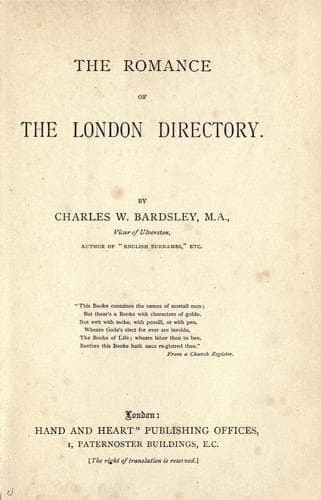
The Romance of the London DirectoryBardsley, Charles Wareing Endell
History
The Romance of the London Directory
Bardsley, Charles Wareing Endell
Names, English -- England -- London; Names, Personal -- England -- London
“What baron, or squire, or knight of the shire
Lives half so well as a holy Fry-er?
In doing well thou must be reckoned
The first—and Mrs. Fry the second.”
Again he says in jest and rhyme, with a sly hit in the last line at her
Quaker garments:—
“I like you, Mrs. Fry! I like your name!
It speaks the very warmth you feel in pressing
In daily act round Charity’s great flame—
I like the crisp Browne way you have of dressing.”
If Hood had known the meaning of Mrs. Fry’s name, he could have made a
better play than this upon it. The forms in the old rolls are Walter le
Frie, or Roger le Frye.
The country police were represented by various terms, and as I turn the
page of my book of modern reference I am reminded of them all. The
Hayward guarded the fences; the Forester or Forster or Foster, the
Woodward, the Parker, the Warrener or Warner, the Woodreeve, now found as
Woodruff or Woodroff, all protected the covers wherein the beasts of the
chase found harbourage. The Pinder, or Pounder, was engaged in locking
up strayed cattle. Every village had its pound, and no doubt in a day
when hedges and dikes and fences were less familiar sights than now, his
office would be an important one.
It may be asked, Have we any relic in our Directories of any office in
the large towns answering to our modern policeman, or “peeler,” as our
street _gamins_ so disrespectfully style him? We answer in the
affirmative. Our somewhat common surname of Catchpoll, Catchpole,
Catchpool, and Catchpoole are his representatives. They were so called
because, as they walked their beat, they carried a somewhat formidable
weapon, very like a pitchfork, the two prongs of which slipped round the
neck, and formed a steel collar. The officer then had the criminal
entirely at his mercy, and could either drag him, or shove him by the
pole attached, which was from six to seven feet, in length. He was
called a Catchpoll, because he _caught_ his victim by the head or _poll_.
We still talk of a poll-tax, or “going to the poll,” showing how familiar
the word was in those days. The Malvern Dreamer, in his poem entitled
“The Vision of Piers Plowman,” says of the two thieves crucified with our
Saviour, that,—
“A cachepol cam forth,
And cracked both their legges.”
Public-domain text, read in full here on John Shaqi.
Reviews
Reviews
No reviews yet
Be the first to share your thoughts on this work.
Join the Discussion
Join the discussion
Sign in to leave a comment or review.
Sign InorCreate an account