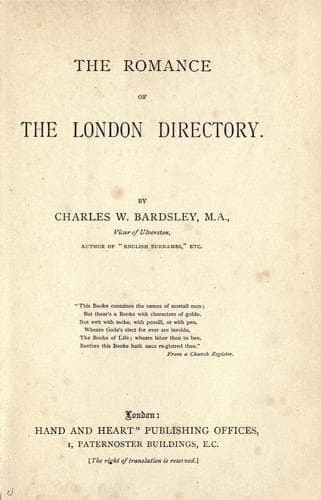
The Romance of the London DirectoryBardsley, Charles Wareing Endell
History
The Romance of the London Directory
Bardsley, Charles Wareing Endell
Names, English -- England -- London; Names, Personal -- England -- London
NOTHING would be easier than to occupy a half-dozen chapters with a
relation of the mode in which our forefathers led their lives. It is one
peculiarity of nomenclature, that it reaches into every nook and crevice
of English customs. What our ancestors specially favoured in the way of
meat and drink, is set down with the utmost particularity in the London
Directory of to-day, while, on the other hand, it is by the absence of
certain names therein that we can form a safe judgment of what delicacies
they lacked. No one would expect to see the potato commemorated in the
Directory, for the simple reason that it was introduced into England
after surnames had become established on a solid basis. There are no
“Tatermans” or “Taterers.” But such names as Appletree, Appleyard,
Plumtree, Pearman, and Peascod, exist. Why? Because apples, pears,
plums, and peas, have been familiar to Englishmen for a dozen centuries.
“Photographer” is not in the Directory for the same reason, but “Limner”
is, the old “illuminator.” “Cabman” is also conspicuous by its absence,
but “Carman” and “Wagner” (_i.e._ Wagoner) exist. Had tea, or umbrellas,
or broughams, or balloons, or carpets, or potatoes, or croquet balls, or
telegraph wires, or tinned meats, or steam engines, or churchwarden
pipes, or Indian pickles, been introduced about five hundred years ago,
every one of these would have left its mark on our personal nomenclature.
Each would have found itself commemorated in our directories as well as
our dictionaries. It is true the railway engine might seem to have been
referred to in such fourteenth-century registrations as Richard le
Engineur or William le Genour, but these men only wielded the great
battering-rams, or catapults, or engines for hurling stones. Very
destructive they were, of course, and so important a profession that no
wonder there are thirteen “Jenners” in the London Directory alone. Sir
William Jenner can satisfy himself with the reflection that if his
progenitor was distinguished for the number of England’s adversaries he
placed _hors de combat_, he and his father have been equally remarkable
for the number of lives they have saved.
Public-domain text, read in full here on John Shaqi.
Reviews
Reviews
No reviews yet
Be the first to share your thoughts on this work.
Elsewhere in the archive
Join the Discussion
Join the discussion
Sign in to leave a comment or review.
Sign InorCreate an account