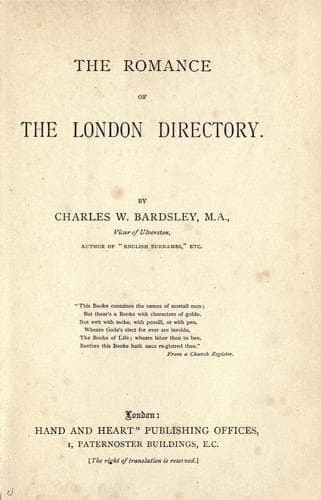
The Romance of the London DirectoryBardsley, Charles Wareing Endell
History
The Romance of the London Directory
Bardsley, Charles Wareing Endell
Names, English -- England -- London; Names, Personal -- England -- London
Let us spend a few moments in a consideration of this great matter of
eating and drinking. And we will begin with drinking first. It is
curious how easily misled we might be by the corruptions that have taken
place in our nomenclature. The following surnames are in the London
Directory (1870): Brandy, Sherry, Gin, Port, Beer, Porter, Stout, Claret,
Portwine, Tee, and Coffee. Not one of these is what it seems to be. Not
one of these has anything to do with the beverage each severally
represents. “Portwine” is a mere modernisation of “Potewyne,” which in
the fourteenth century denoted the Poict tevine settler in England.
“Claret” was the pet name of “Clare.” “Stout” is of the nickname class,
“Porter” occupative, and “Port” is found originally as “Charles le Port,”
or “Oliver le Port,” showing that it was a sobriquet having reference to
the portly bearing of the progenitor. Tennyson speaks of
“A modern gentleman
Of stateliest port.”
It is the same with “Aleman.” This has no connection with the
public-house, but like “Almaine” and “D’Almaine” represents the old
German trader. The word was once in most familiar use. Coverdale’s
exposition of the twenty-fifth Psalm has on the title page, “Translated
out of hye Almayne (High Dutch) in to Englyshe, by Myles Coverdale,
1537.” No one will require me to prove that James Tee and Peter Coffee
do not represent our modern and favoured national breakfast beverages.
At least the first, if he did, must have sprung from some “heathen
Chinee,” who has immigrated to our shores. Such an elucidation, however,
would neither satisfy myself, my reader, nor James Tee himself, I
imagine.
But we have quite sufficient relics of the drinking propensities of the
English people in bygone days without seeking for them in their corrupted
forms. “Inman” and “Taverner” both represent the old keeper of houses of
entertainment. _Tavern_ is going out of fashion: _Public-house_ is a
modern term. Porson, the great Greek scholar, was unhappily given to
drink; but drunk or sober he had ever a Greek or Latin quotation at the
tip of his tongue. Reeling in the streets of Cambridge, he one day
tumbled down a flight of steps into a cellar-tavern. As they picked him
up, he was heard to mutter,
“Facilis est descensus t-averni.”
Our Church of England temperance lecturers could not take a better text
than this clever pun; for, unlike most puns, it contains a most
admonitory truth. An old tavern-sign in Cheshire, in the last century,
bore the following inscription:
“Good _bear_ sold here, our own _bruin_.”
Public-domain text, read in full here on John Shaqi.
Reviews
Reviews
No reviews yet
Be the first to share your thoughts on this work.
Elsewhere in the archive
Join the Discussion
Join the discussion
Sign in to leave a comment or review.
Sign InorCreate an account