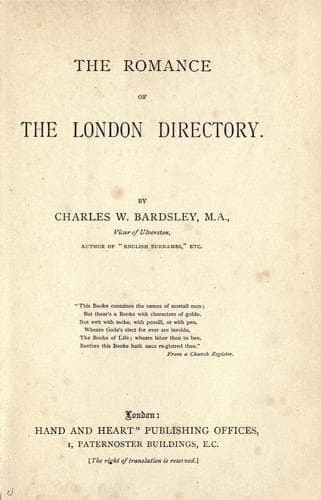
The Romance of the London DirectoryBardsley, Charles Wareing Endell
History
The Romance of the London Directory
Bardsley, Charles Wareing Endell
Names, English -- England -- London; Names, Personal -- England -- London
{107} A curious instance in point will be found in the marginal reading
of Malachi ii. 12, where “master, and scholar,” in the text, is
marginally translated, “him that waketh, and him that answereth.” Now,
we know the corresponding duties of master and scholar. The master asks
his question, and then _watches_ for the reply. “Him that watcheth, and
him that replieth,” would be understood by all readers. “Him that
waketh, and him that answereth,” will probably seem unmeaning to nineteen
out of twenty average students.
{120} In this last record there is also a “Thomas le Sober.”
{122} I must not let this statement pass without saying that the
termination “ster” is not admitted to be feminine by all philologists; in
fact, it is the subject of much contention. It will be quite sufficient
for my purpose simply to draw attention to the existence of this twofold
desinence in “er” and “ster,” because it occurs more frequently in the
directory than the dictionary. I have had the opportunity of proving
this in “English Surnames” (2nd edition, p. 380 and elsewhere), so I will
only add that very often where the dictionary has dropped one form the
directory has preserved it, and _vice versâ_. For instance, there are
five Treachers and two Trickers in the London Directory. We do not now
speak of a tricker but a “trickster.” Of course the meaning of a
“treacher” or “tricker” has become forgotten or confused, otherwise our
friends bearing that name would long ago have shuffled it off. Webster
still has the word, but he adds that it is an obsoletism. We only talk
of a beggar now, but “Joan Beggister” occurs in an old roll. It is
curious to note how the weaving and dyeing of cloth have left the double
forms. We only speak of a dyer now, but “Dyer” and “Dyster” figure in
the London Directory. On the other hand, the dictionary has both
“whiter” and “whitster,” and “thrower” and “throwster,” the directory
only “Whiter” and “Thrower.” Again, the directory alone contains
“Blaxter” (bleachster), the dictionary alone _bleacher_. A _litter_ of
cloth (_i.e._ dyer), or a _kemper_ of wool seems never to have existed,
for only “Lister” is a surname—once written “Litster”—and “Kempster.” I
have already mentioned Webber and Webster. We should think it odd to
hear people talk of a “_bellringster_,” or a “_breadmongster_,” or a
“_washster_,” but so they did some generations ago. “Spinner” has never
been a surname, nor “spinster,” but the latter had no chance on account
of the secondary sense that so quickly attached to it. I cannot end this
note without once more drawing the attention of philologists to the
advantages of using the _directory_ as a complement to the _dictionary_.
Public-domain text, read in full here on John Shaqi.
Reviews
Reviews
No reviews yet
Be the first to share your thoughts on this work.
Elsewhere in the archive
Join the Discussion
Join the discussion
Sign in to leave a comment or review.
Sign InorCreate an account