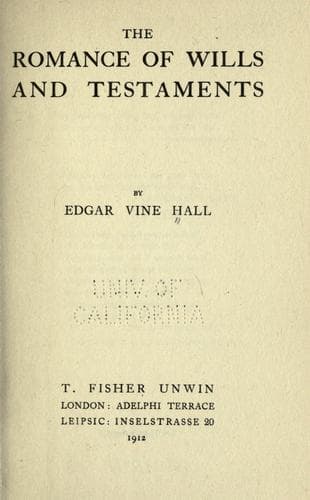
The Romance of Wills and TestamentsVine Hall, Edgar
History
The Romance of Wills and Testaments
Vine Hall, Edgar
Wills -- Great Britain -- Miscellanea
Dean Cheyney, it will be remembered, made an addendum to his will,
“Now about to go to London, in case I never return.” It was a natural
precaution, but the Dean, as has been noticed, was haunted by the sense
of his mortality. More natural was it to make a will when about to go
to the wars. The earliest form of Roman will was, in fact, that made
_in procinctu_ or on the eve of battle. English wills have frequently
been made on the eve of an engagement or a war. So Ralph Gascoigne, of
Wheldale (1522), makes his will “intending to go to the King’s wars
when it shall please his grace,” and Walter Paslew, of Riddlesden
“intending by the grace of God, according to the King’s commandment, by
his letters to me directed shortly to take my journey toward the Scots
for the defence of the realm of England.” Captain James Ableson (1665)
declares his “true intent ... in case it should please God he should
be slain,” and James Rookes (1665) “being a single man and likely to
go through a deep engagement very suddenly, knowing not how it will
please God to deal with me.” So Captain Crawley, at a critical moment
in “Vanity Fair,” busies himself with his will.
Of peculiar interest is the will of Lieutenant-Colonel Frederick
Thomas, made on the eve of a duel: “London, 3rd September, 1783. I am
now called upon, and, by the rules of what is called honour, forced
into a personal interview of the most serious kind with Colonel Cosmo
Gordon: God only can know the event, and into His hands I commit
myself, conscious only of having done my duty. I therefore declare
this to be my last will and testament, and do hereby revoke all former
wills.... In the first place I commit my soul to Almighty God, in hopes
of His mercy and pardon for the irreligious step I now (in compliance
with the unwarrantable customs of a wicked world) feel myself under
the necessity of taking.” The will was proved eight days later. Lord
Viscount Falkland, on the other hand, made his will when mortally
wounded after a duel at Chalk Farm in 1809.
Public-domain text, read in full here on John Shaqi.
Reviews
Reviews
No reviews yet
Be the first to share your thoughts on this work.
Elsewhere in the archive
Join the Discussion
Join the discussion
Sign in to leave a comment or review.
Sign InorCreate an account