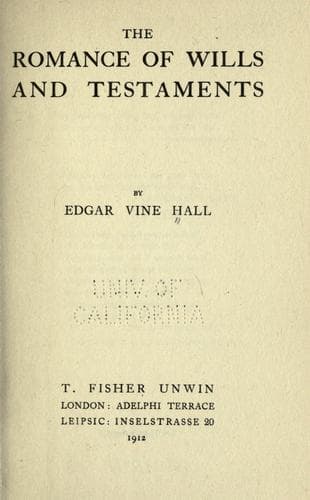
The Romance of Wills and TestamentsVine Hall, Edgar
History
The Romance of Wills and Testaments
Vine Hall, Edgar
Wills -- Great Britain -- Miscellanea
The artist W. P. Firth, like many others in recent times, requested
that his body should be cremated, saying that “the duty of the
individual to his kind includes providing for such final disposal of
his body as shall be least detrimental to those who survive him, and
that the modern process of incineration provides the quickest and
safest mode of such disposal.”
As unsentimental was the mind of the New York citizen who instructed
his executors to have made out of his bones circular buttons of
dimensions from one half an inch to one inch in diameter, to have the
skin of his body tanned and made into pouches; and to have violin
strings made out of such parts as might be suitable, adding: “I hereby
give unto my beloved friend James Hayes the buttons, violin-strings and
tanned skin made out of my body as aforesaid, the same to be by him
distributed according to his discretion to my intimate friends.” The
belief, it is said, that in the human body exists useful material which
should not be wasted led this testator to give such strange directions:
he did not believe in ordinary unhygienic and wasteful modes of burial,
and hoped that his example might be followed.
With the will of John Angell, of Stockwell, dated September 21, 1774,
we may make an end. He seems to have been a man of ambitious ideas.
He made provision for a “College or Society of seven decayed or
unprovided for gentlemen,” and had the temerity to name as trustees the
Archbishops of Canterbury and of York and the Lord Chancellor, “the
great personages whom I have presumed to appoint to this trust,” as he
himself says.
Public-domain text, read in full here on John Shaqi.
Reviews
Reviews
No reviews yet
Be the first to share your thoughts on this work.
Elsewhere in the archive
Join the Discussion
Join the discussion
Sign in to leave a comment or review.
Sign InorCreate an account